

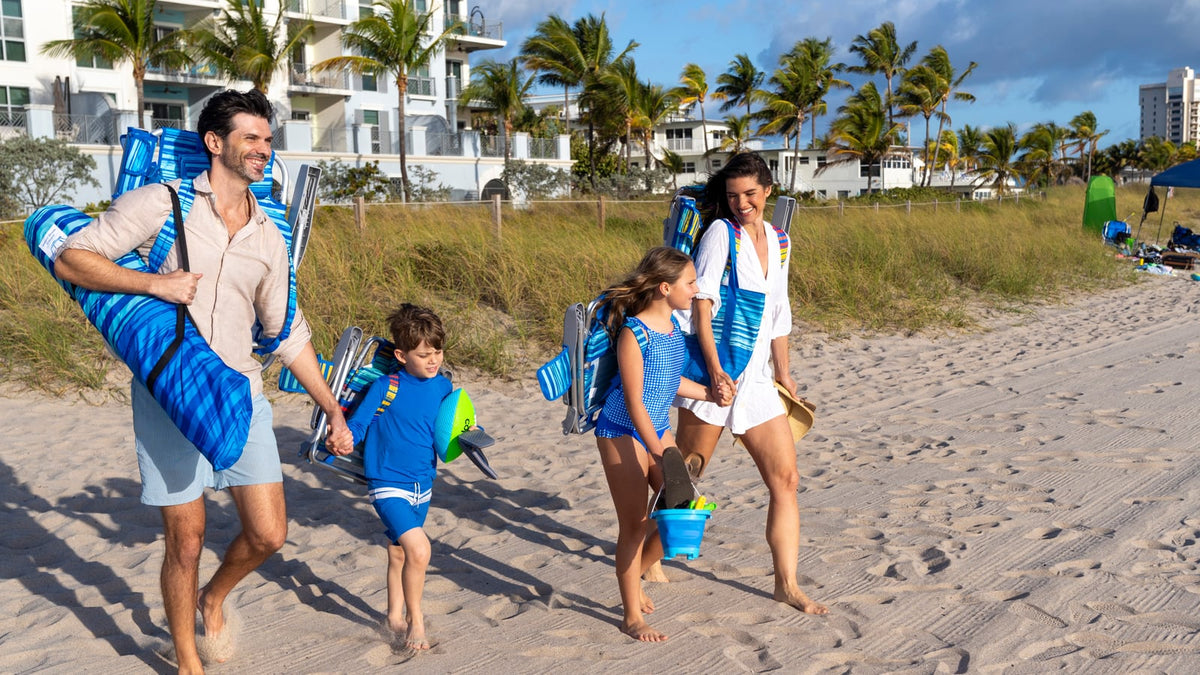
Here is an uncomfortable truth most beach gear guides skip entirely: the chair that works perfectly for one member of your family may be completely wrong for another. A low-slung lounger that your teenager loves will strain your father-in-law's knees. The compact folding chair that fits your beach bag will leave your toddler with no support and your partner with a sore back by noon. Most families discover this the hard way, hauling a mismatched collection of chairs down to the shoreline only to spend the afternoon listening to complaints instead of waves.
Choosing family beach chairs is not a single purchasing decision. It is a system design challenge. Every person in your group, from a two-year-old building their first sandcastle to a grandparent who needs lumbar support to enjoy an afternoon outside, has genuinely different physical requirements, comfort needs, and usage patterns. The chair that checks all the boxes for one person actively fails another.
This guide takes a multigenerational approach to beach chair selection. Instead of recommending "the best beach chair" as if every body is the same, it breaks down exactly what each age group needs, what features matter most at each life stage, and how to build a coordinated set of premium beach chairs for families that actually works for everyone. You will also find a practical decision framework, a feature comparison matrix, and specific guidance on integrating chairs into a complete beach setup, so your next family beach day feels less like a logistics operation and more like the relaxing escape it was supposed to be.
Why "One Size Fits All" Beach Chairs Are a Myth Worth Challenging
The premise that a single beach chair design can serve every family member equally is convenient for retailers but genuinely problematic for real families. When you examine the physical and ergonomic requirements across different age groups, the gaps become obvious, and the consequences of ignoring them range from mild discomfort to real safety concerns.
Consider what a beach chair actually needs to accomplish. It must provide postural support appropriate to the user's height and weight. It must allow entry and exit without strain. It must maintain stability on sand, which shifts under load differently than hard flooring. It must stay comfortable for extended periods, often two to six hours during a full beach day. And it must do all of this in a hot, humid, salt-air environment where materials degrade faster and grip becomes unpredictable when wet.
The Ergonomic Gap Between Adults and Children
Adult-sized beach chairs are designed with adult proportions in mind. Standard seat heights, arm placements, and backrest angles are calibrated for bodies that are typically 5 feet 2 inches to 6 feet 2 inches tall. A toddler placed in a standard adult beach chair is not just uncomfortable, they are in a chair that offers no meaningful support for their spine, no footrest to prevent dangling legs from cutting off circulation, and no side support to prevent lateral falls. The chair designed for maximum relaxation in an adult becomes a mild safety hazard for a small child.
At the other end of the spectrum, low-profile beach chairs, which sit very close to the ground and recline deeply, present serious challenges for older adults. Getting in and out of a low chair requires significant hip flexor and quadriceps strength, along with good balance. For anyone managing arthritis, reduced mobility, or recovering from joint replacement, a deeply reclined low chair is not a relaxing option. It is a trap they dread leaving.
What "Premium" Actually Means in Beach Chair Design
The word premium gets applied loosely across the beach gear market. In the context of comfortable beach chairs for adults and family-grade seating, premium should mean a specific set of engineering decisions: frame materials that resist corrosion in salt air, fabric that dries quickly and does not hold mildew, weight ratings that account for real-world use rather than theoretical limits, and ergonomic geometry that supports the spine in a way that allows extended sitting without pain.
Premium also means intentional design for the environment where the product will be used. Beach sand is an aggressive abrasive. Hinges, folding mechanisms, and frame joints that work perfectly in a showroom can seize or strip after repeated exposure to fine sand if they are not designed with that reality in mind. A truly premium beach chair has been engineered for the actual conditions of beach use, not just aesthetic appeal or price point optics.
This distinction matters when you are building a coordinated set of multigenerational beach chairs for a family group. Investing in chairs that will last multiple seasons, across multiple users, is more economical and more sustainable than replacing budget chairs every summer.
What Toddlers and Young Children Actually Need in a Beach Chair
Selecting the right beach chairs for toddlers requires setting aside what parents find convenient and focusing on what children actually need physically and developmentally. The requirements are specific, and most generic beach chairs fail to meet them entirely.
Size and Proportionality
A chair sized for a toddler or young child should have a seat height that allows their feet to rest flat or close to flat, rather than dangling. Dangling legs cut off circulation at the back of the thighs and become uncomfortable within minutes. The seat depth should be shallow enough that the child can sit back against the chair back without the front edge pressing behind their knees. Chair backs should be high enough to support the child's head and neck when they inevitably lean back to look up at the sky or doze off in the afternoon heat.
Side arms, or at minimum solid lateral support, are important for younger children who are still developing their core stability and balance. A child who shifts their weight suddenly while reaching for a snack needs something to prevent them from tipping sideways. On soft sand, this is even more critical because the ground itself is not stable.
Material Safety and Sun Considerations
Children's skin is more sensitive to heat than adult skin, and chair materials that become hot to the touch in direct sun can be genuinely uncomfortable or even harmful for small children. Metal frame components that are exposed should be minimal, and fabric choices matter both for comfort and for drying quickly after a child inevitably gets wet and sits back down. Breathable mesh or quick-dry fabrics are preferable to materials that retain moisture and stay damp through a long afternoon.
Stability on sand is also more important for children's chairs than adults often realize. A chair with a wider foot base and heavier build-quality will not tip when a toddler throws their weight forward to watch something in the water. This is not a minor comfort issue. It is a basic safety requirement for a beach environment where falls happen on hard-packed wet sand at the water's edge.
The Transition Years: Ages 5 Through 10
Children in this age range present a particular challenge. They have outgrown toddler-specific gear but are not large enough to use adult chairs comfortably or safely. Many families default to having these children use adult chairs unsatisfactorily, which results in children abandoning the chairs entirely and sitting on towels on the sand, which is fine for them but means the chair investment goes unused.
A better approach is to look for adult chairs with adjustable seat configurations or to invest in youth-sized chairs that can accommodate the 50-to-100-pound weight range comfortably. Some premium beach chair lines offer scaled designs that work for this transitional size range without requiring a full adult-sized frame.
What Adults in Their Prime Years Need from a Beach Chair
Adults between roughly 25 and 55 represent the widest range of beach chair users in terms of physical requirements, but they share a core set of needs that distinguish quality beach seating from mediocre alternatives. Comfortable beach chairs for adults in this age range should prioritize lumbar support, seat fabric quality, adjustability, and structural integrity under real-world loads.
Lumbar Support and Postural Geometry
The single most common complaint about beach chairs from adult users is lower back pain after extended sitting. This is not a matter of personal sensitivity. It is a structural failure of the chair design. Most low-cost beach chairs have a flat or concave seat back that provides no lumbar support, causing the lower back to round outward as the user relaxes. Over one to two hours, this creates significant tension in the lumbar muscles and can trigger pain that persists well beyond the beach day itself.
A well-designed adult beach chair should have a backrest with a slight curve or built-in lumbar support contour. Some premium designs achieve this through the geometry of the frame itself. Others use padded inserts or structured fabric panels. Either approach works as long as the result is a seat back that supports the natural inward curve of the lumbar spine rather than forcing it to flatten.
Adjustable Recline Positions
No single recline angle works for every activity or every adult body. Reading a book benefits from a more upright position. Napping in the sun calls for a deeper recline. Watching children near the water requires a position that allows easy and quick standing without a full postural reset. The best adult beach chairs offer at least three distinct recline positions, ideally with a locking mechanism that holds the chosen angle even when the user shifts their weight.
Adjustability also matters for adults with varying physical conditions. Someone managing a recovering shoulder injury may need a more upright position. Someone with hip issues may prefer a more reclined posture that reduces hip flexion angle. A chair with multiple positions accommodates these variations without requiring a specialized purchase.
Weight Capacity and Frame Integrity
Weight ratings on beach chairs are often presented as a maximum load, but the real question is how the chair performs across extended use at various loads within that range. A chair rated to 300 pounds that becomes structurally stressed at 250 pounds, developing flex in the frame or creaking joints, is not adequately engineered. Premium adult beach chairs should feel solid and stable at any weight within their stated range, without flex, wobble, or audible stress in the frame.
Frame materials for quality adult beach chairs are typically powder-coated aluminum or high-grade steel with rust-resistant treatment. Aluminum is lighter, which matters for portability. Steel is typically more rigid, which matters for structural feel. The best family beach chairs balance these priorities based on who will be carrying them and how far.
Multigenerational Beach Chairs: Designing for Older Adults and Grandparents
Older adults are the most underserved demographic in the beach chair market. Most beach chair design is optimized for physically capable adults in their prime years, and the adjustments needed for older users, particularly those managing reduced mobility, joint pain, or balance challenges, are substantial enough to warrant treating this as a separate category entirely.
Seat Height Is the Critical Variable
The single most important factor for older adults in a beach chair is seat height. A chair that sits too low makes getting in and out of the chair a physically demanding and potentially unsafe task. The optimal seat height for an older adult allows them to lower into the chair by bending their knees to roughly 90 degrees and push back to standing without needing to rock forward and generate momentum. This is a function of both the chair's height from the ground and the angle of the seat, since a steeply reclined chair effectively lowers the functional seat height even if the frame height is adequate.
For most older adults, a seat height of 16 to 20 inches from the ground provides the right range. Chairs that sit at 10 to 12 inches from the ground, which is common in low-profile beach chairs marketed for their "lay-flat" convenience, are genuinely problematic for anyone managing arthritis, hip replacement history, or reduced lower body strength.
Armrests as Functional Support Structures
Armrests on beach chairs are often treated as a comfort feature, a place to rest a drink or lay an arm. For older adults, they are functional support structures that enable safe entry and exit from the chair. The armrests need to be positioned at the right height relative to the seat, typically 7 to 9 inches above the seat surface, to allow the user to push down on them effectively when standing. They also need to be structurally solid, not flex under the 30 to 50 pounds of downward pressure a person might apply when pushing themselves to standing.
Flimsy armrests that wobble or collapse under load are not just annoying. For an older adult using them for balance support, they represent a fall risk. When evaluating beach chairs for older family members, test the armrests specifically by pressing down firmly and checking for lateral flex or joint instability.
Back Support and Head Rest Positioning
Older adults often experience cervical spine stiffness or tension that makes resting in a chair without head support uncomfortable over extended periods. A chair back that extends to support the head and neck, or that includes a headrest cushion, dramatically increases comfort for this age group. The headrest should be positioned to support the head in a neutral position, neither craning forward nor hyperextending back, which means its height needs to be appropriate for the user's seated height.
For multigenerational beach chairs designed to serve the full family, the adjustability of the backrest and headrest position becomes particularly valuable, since it allows the same chair to work for a 5-foot-4-inch grandmother and a 6-foot-2-inch adult son without requiring separate purchases.
How to Build a Coordinated Family Beach Chair System
The most effective approach to premium beach chairs for families is to think in terms of a system rather than individual purchases. A coordinated system means that every chair in your group is chosen to work together logistically (similar carry bags, compatible storage), meets the specific needs of each user, and integrates with your other beach gear including shade, bags, and anchoring solutions.
Mapping Your Family's Specific Needs
Before purchasing anything, create a simple inventory of your family's beach group. List every person who regularly joins your beach outings, their approximate age and any relevant physical considerations, and what they typically do at the beach. Someone who spends most of their time in the water needs a different chair than someone who will spend four hours reading. A grandparent who prefers to stay in shade needs a chair that works under a beach umbrella without being too wide.
This mapping exercise often reveals that a family of five or six needs two or three different chair types rather than six identical units. You might need two high-seat adult chairs for grandparents, two standard adult recliners for parents, and one or two youth-sized options for younger children. That combination costs roughly the same as buying six of the wrong chair and serves everyone dramatically better.
Coordinating Chairs with Shade Solutions
Beach chairs do not exist in isolation. They sit under umbrellas, inside cabanas, and around shade structures, and the physical dimensions of your chairs need to work within your shade footprint. A beach umbrella with a 7.5-foot diameter canopy covers a specific ground area. If your chairs are too wide or if you need to seat too many people under one umbrella, you will have people sitting in direct sun despite having shade equipment.
Copa's shade solutions, including their beach umbrellas and cabana structures, are designed to work in coordination with their chair lineup. The Anchor Max system, Copa's patented anchoring technology for shade structures, provides exceptional stability in the sand without the wobbling or tipping that plagues standard umbrella poles in beach conditions. When your shade is anchored securely and your chairs are sized to fit within that shade footprint, the entire setup works as a cohesive system rather than a collection of mismatched parts.
For families building a complete beach setup from scratch, Copa's bundle packages, including the Deluxe Bundle and Essentials Bundle, are worth examining because they are curated specifically to ensure that the chairs, shade, and accessories work together as a system. This eliminates the guesswork of compatibility and ensures that everything arrives ready to function as a coordinated unit. You can explore the full range of Copa's complete beach setup options for families to understand how the components work together before purchasing.
Portability and the Weight Distribution Question
A family beach chair system that cannot be efficiently transported from the parking lot to the shore is a system that will not get used. This is a genuine practical constraint that often gets overlooked in the excitement of evaluating features and comfort. Every chair in your lineup should have a designated carry solution, whether that is a shoulder strap, a carry bag, or a backpack-style carry system, and the total carry load should be distributed across your group realistically.
If you are regularly heading to the beach with young children, your carry capacity as parents is severely limited because you are already managing children, bags, food, and gear. Lightweight chairs with integrated carry straps are not a luxury in this scenario. They are a practical necessity. A chair that is comfortable but requires two hands and significant effort to carry is effectively unusable for a parent who needs one hand free for a child's hand and another for a cooler bag.
The Feature Comparison Matrix: What to Prioritize by Family Member
Use this matrix to evaluate any beach chair against the specific needs of each family member type. Rate each feature as essential, helpful, or not applicable based on the user.
| Feature | Toddlers (1-4) | Young Children (5-10) | Teens | Adults (25-55) | Older Adults (60+) |
|---|---|---|---|---|---|
| High seat height (16"+) | ❌ Too high | ⚠️ Depends on size | ✅ Helpful | ✅ Helpful | ✅ Essential |
| Lumbar support contour | ⚠️ Nice to have | ⚠️ Nice to have | ✅ Helpful | ✅ Essential | ✅ Essential |
| Solid structural armrests | ✅ Essential (safety) | ✅ Helpful | ⚠️ Nice to have | ✅ Helpful | ✅ Essential |
| Multiple recline positions | ❌ Not needed | ⚠️ Nice to have | ✅ Helpful | ✅ Essential | ✅ Helpful |
| Head and neck rest | ✅ Essential | ✅ Helpful | ✅ Helpful | ✅ Helpful | ✅ Essential |
| Wide stable base on sand | ✅ Essential (safety) | ✅ Essential | ✅ Helpful | ✅ Helpful | ✅ Essential |
| Lightweight carry system | ✅ Essential (parent carries) | ✅ Helpful | ✅ Helpful | ✅ Essential | ✅ Essential |
| Quick-dry breathable fabric | ✅ Essential | ✅ Essential | ✅ Helpful | ✅ Helpful | ✅ Helpful |
| Cup/accessory holder | ❌ Not needed | ⚠️ Nice to have | ⚠️ Nice to have | ✅ Helpful | ✅ Helpful |
| Corrosion-resistant frame | ✅ Helpful | ✅ Helpful | ✅ Helpful | ✅ Essential | ✅ Essential |
Copa's Approach to Family Beach Seating: What Sets It Apart
Copa has built its entire product philosophy around the premise that families deserve beach gear that works for everyone in the group, not just the average adult. That orientation shows up not just in the product design but in how the brand thinks about the beach experience as a whole system.
The Anchor Max Technology and Why It Matters for Chair Placement
One aspect of Copa's product line that directly affects how you use your family beach chairs is the Anchor Max anchoring system used in their shade structures. Most families position their beach chairs in relation to their umbrella or shade structure, which means the stability and positioning of the shade determines where the chairs can go. When a standard umbrella wobbles, tilts, or needs to be repositioned frequently due to wind, it disrupts the entire seating arrangement and forces constant adjustments.
Copa's Anchor Max technology is a patented system that drives the umbrella pole anchor deep into the sand using a corkscrew-style mechanism, creating a hold that resists lateral force from wind gusts without the anchor migrating upward over time the way surface-level stakes do. This means your shade structure stays where you put it, which in turn means your chairs can stay arranged around it in the configuration that works best for your family group. For multigenerational setups where grandparents need the deepest shade and parents need to face the water to watch children, a stable anchor point is not a minor convenience. It is the structural foundation of your entire beach setup.
The practical result of using the Anchor Max system is that you spend less time managing your shade equipment and more time actually sitting in your chairs, which is the point of the whole exercise.
Copa's Chair Design Philosophy
Copa's beach chairs are designed with the specific demands of full-day family beach use in mind. The materials selected for frames and fabric prioritize salt-air resistance and durability without adding unnecessary weight. The seat geometry is calibrated for extended sitting comfort, addressing the lumbar support gap that causes back pain in lower-quality chairs. And the carry systems are designed to be manageable for adults who are already managing children, bags, and beach gear.
The brand's Brazilian beach heritage is not just a marketing story. Brazilian beach culture has some of the world's most sophisticated and deeply ingrained beach-going traditions, and the design sensibility that comes from that culture emphasizes functionality, comfort, and style as equally important priorities. A chair should be beautiful to look at and genuinely comfortable to sit in, not one or the other.
For families who want to see how Copa chairs fit into a full beach day plan, the ultimate family beach packing list on Copa's Beach Tips blog offers a comprehensive framework for building your complete kit around the chairs as a centerpiece.
Common Mistakes Families Make When Buying Beach Chairs (and How to Avoid Them)
After examining what good family beach chair selection looks like, it is worth naming the specific mistakes that lead families to the wrong purchases. These patterns appear consistently, and recognizing them before you shop can save both money and frustration.
Mistake 1: Buying Based on Price Per Chair Rather Than Value Per Use
The most common family beach chair mistake is optimizing for the lowest cost per chair rather than the highest value per beach day. A set of $15 folding chairs looks like a bargain until two of them fail within the first season, one develops a bent frame that makes it uncomfortable, and you spend two beach days listening to complaints about back pain.
Premium beach chairs cost more upfront but deliver a fundamentally different experience over their lifespan. A quality chair that lasts five seasons and provides genuine comfort on every beach day has a much lower real cost than a budget chair replaced annually. More importantly, it provides a better experience on every single use, which is the actual purpose of the purchase.
Mistake 2: Buying All the Same Chair for Everyone
The convenience of buying a matching set is understandable, but it is almost always the wrong decision for a multigenerational family. Unless every member of your beach group has nearly identical physical needs, a single chair design will serve some people well and others poorly. The investment in a coordinated but differentiated set, with different chair types for different family members, pays dividends in everyone actually enjoying their beach experience.
Mistake 3: Ignoring the Setup and Teardown Experience
A beach chair that takes five minutes to set up and another five to collapse and pack is a chair that will get used less. At the end of a long beach day with tired children, complex folding mechanisms feel like punishment. The best family beach chairs fold and unfold intuitively and quickly, with mechanisms that work even when hands are sandy and wet.
Test any chair's folding and unfolding mechanism before purchasing if possible, or look specifically for user reviews that address this. Glowing reviews about comfort mean nothing if the chair takes two people and three attempts to close.
Mistake 4: Forgetting About Storage at Home
Beach chairs that live in your garage or storage space for most of the year need to store efficiently. A set of chairs that requires a significant dedicated floor space, or that cannot be stacked or hung, creates an organizational problem that compounds over time. Premium chairs with well-designed carry bags or folded profiles that stack neatly represent a more complete design solution than chairs that are comfortable on the beach but awkward everywhere else.
Mistake 5: Not Considering the Shade Integration
Chairs chosen without considering the shade setup they will be used with can result in chairs too wide to fit under an umbrella, too tall to fit inside a cabana, or positioned in a way that conflicts with the shade structure's anchor point. Building your beach system with shade and seating chosen in coordination, as Copa's bundle approach encourages, eliminates this compatibility problem entirely.
A Decision Framework for Choosing the Right Chair for Each Family Member
Rather than leaving chair selection as an open-ended evaluation, here is a structured decision framework you can apply to each member of your family group. Work through these questions for each person, and the right chair type will become clear.
Step 1: Identify the Primary Physical Constraint
For each family member, ask: what is the primary physical constraint that a chair must accommodate? For toddlers, it is size and safety. For older adults, it is entry and exit ease. For adults with back issues, it is lumbar support. For children in transition ages, it is appropriate proportionality. The primary physical constraint determines the non-negotiable features the chair must have.
Step 2: Identify the Primary Use Pattern
How does this person actually use a beach chair? Some people sit in their chair for four to six hours with minimal movement, reading or napping. Others get in and out constantly, going to the water, helping children, getting snacks. A person who gets in and out frequently needs a chair that is easy to exit and re-enter. A person who stays seated for long periods needs superior extended-sitting comfort, particularly lumbar support and breathable fabric.
Step 3: Identify the Portability Requirement
Who is carrying this chair, and how far? If a grandparent is expected to carry their own chair, weight and carry mechanism are critical. If a parent is carrying a child's chair in addition to their own gear, the child's chair must be very light. If you drive directly to a beach parking lot that is adjacent to the sand, portability matters less than if you walk half a mile from a distant lot.
Step 4: Check Compatibility with Your Shade Setup
Measure or estimate the shade coverage your umbrella or cabana provides. Confirm that the chairs you are considering can be arranged within that footprint with adequate spacing. For Copa's shade structures using the Anchor Max system, the anchor point is fixed once set, so your chair arrangement needs to work around that central point. Most families find that a 7.5-foot umbrella comfortably covers two adult chairs with a small cooler between them, or one adult chair and one youth chair side by side.
Step 5: Evaluate the Total System Cost
Once you have identified the right chair type for each family member, evaluate the total cost of the complete set against your budget. If the total exceeds your budget, prioritize the chairs for family members with the strongest physical requirements first. Grandparents with mobility considerations and toddlers with safety requirements should be prioritized over teens and young adults who can adapt more easily to a wider range of chair options.
Caring for Your Family Beach Chairs to Maximize Their Lifespan
Premium beach chairs are a meaningful investment, and proper care dramatically extends their useful life. The beach environment is one of the most aggressive environments for outdoor furniture, combining salt air, UV radiation, abrasive sand, moisture, and heat in ways that accelerate material degradation.
Post-Beach Cleaning Routine
After every beach outing, rinse your chairs with fresh water before folding them for storage. Salt residue left on metal frames initiates corrosion even on rust-resistant finishes. Sand embedded in folding joints causes abrasion with every open and close cycle, gradually wearing down the joint surfaces. A quick rinse with a garden hose or a bucket of fresh water after each use removes the majority of both threats.
For fabric components, allow chairs to dry fully before folding and storing them. Folding damp fabric traps moisture against itself, creating conditions for mildew growth that damages fabric and creates persistent odors. If you are returning from the beach and the chairs are still wet, unfold them in a garage or covered area until they dry before storing.
Seasonal Inspection and Maintenance
At the beginning and end of each beach season, inspect every chair in your set. Check folding joints for signs of corrosion, grit accumulation, or mechanical wear. Check fabric seams for fraying or UV degradation. Check frame welds and attachment points for any developing cracks or stress fractures. Catching these issues early, when they can be addressed with cleaning or minor repair, prevents the progressive deterioration that turns a repairable chair into a discarded one.
Apply a silicone lubricant to folding joints once per season to keep mechanisms operating smoothly and to displace any moisture that has worked its way into the joint spaces. This is a two-minute maintenance task that significantly extends the life of the folding mechanism.
Storage Considerations
Store chairs in a cool, dry location away from direct sunlight during the off-season. Prolonged UV exposure degrades fabric and can cause color fading even in chairs with UV-resistant fabric treatment. A garage, basement, or covered storage area is ideal. If chairs must be stored outdoors, use a breathable cover that keeps moisture out while allowing any trapped humidity to escape.
For families who beach frequently enough that chairs are in semi-permanent use throughout the summer, rinsing after each use and allowing to air dry before the next outing is sufficient. The investment in this basic routine pays returns in chairs that look and function like new after multiple seasons rather than looking worn and performing poorly after one.
Frequently Asked Questions About Family Beach Chairs
What is the best beach chair for a toddler?
The best beach chairs for toddlers are appropriately sized to the child's proportions, with a seat height that allows feet to rest near flat, solid lateral support to prevent tipping, and quick-dry breathable fabric. Safety stability on sand is the most critical feature for this age group. Avoid using adult-sized chairs for toddlers, even with supervision, as the proportions do not provide adequate postural support.
What seat height is best for older adults?
For older adults and seniors, a seat height of 16 to 20 inches from the ground is generally optimal. This range allows comfortable entry and exit without requiring the kind of deep knee bend and hip flexion that low-profile chairs demand. Solid structural armrests at 7 to 9 inches above the seat surface are equally important, providing the push-up support needed to stand safely.
How many beach chairs does a family of four actually need?
A family of four typically needs four chairs, but the types should vary based on the ages of family members. Young children may share a parent's chair occasionally, but having dedicated seating for each person prevents disputes and ensures everyone has appropriate support. If budget is a constraint, prioritize chairs for the family members with the strongest physical requirements first.
What is the difference between a standard beach chair and a premium beach chair?
Premium beach chairs use higher-grade frame materials with better corrosion resistance, fabric that is more durable and breathable, ergonomic geometry that provides genuine lumbar support, and folding mechanisms that operate reliably over multiple seasons. Budget beach chairs typically use thinner frame tubing, lower-grade fabric, and folding joints that degrade quickly under sand exposure. The performance difference becomes apparent within the first season of regular use.
How do I choose a beach chair for someone with back pain?
For someone managing back pain, lumbar support is the non-negotiable requirement. Look for chairs with a seat back that has a natural lumbar curve, multiple recline positions to allow postural adjustment throughout the day, and a seat height that does not require deep hip flexion to enter and exit. Avoid deeply reclined low-profile chairs that force the lumbar spine to flatten.
Can beach chairs be used under a beach umbrella?
Yes, but you need to verify that the chairs fit within your umbrella's shade footprint. Measure the canopy diameter of your umbrella and arrange chairs so that they are within the shadow zone during the hours you plan to use them. Note that the shadow moves with the sun, so a chair in shade at 10 a.m. may be in direct sun by 2 p.m. Copa's Anchor Max system keeps your umbrella fixed and stable so you can arrange chairs in a consistent configuration without the shade drifting.
How do I keep my beach chairs from sinking into the sand?
Chairs with wider foot bases or feet with larger surface area distribute weight more evenly and sink less into soft sand. On very soft sand, placing a small flat board or solid surface under each chair leg can prevent sinking. Some premium beach chairs have wider foot caps specifically designed to address this issue on soft sandy surfaces.
What materials should I look for in a beach chair frame?
Powder-coated aluminum is the most common frame material in quality beach chairs because it is lightweight and resists corrosion in salt air. High-grade steel with rust-resistant treatment is heavier but more rigid. Avoid untreated steel, which will rust rapidly in a salt environment. Check that all joint hardware, screws, and pins are also corrosion resistant, since these small components are often the first failure point in lower-quality chairs.
Is it worth buying a beach chair bundle instead of individual chairs?
For families building a complete beach system, bundle purchases typically offer better value than buying individual components separately. More importantly, curated bundles from brands like Copa ensure that chairs, shade, and accessories are designed to work together as a system. This eliminates compatibility guesswork and ensures everything functions cohesively at the beach. For families who plan to beach regularly, bundles with free shipping provide straightforward, coordinated value.
How do I choose a beach chair for a multigenerational family trip?
Map the physical needs and use patterns of every family member in your group before purchasing. Identify the two or three chair types that together cover the full range of needs, rather than buying one type that partially serves everyone. For multigenerational beach chairs, the most common combination is high-seat chairs with solid armrests for older adults, standard recliners with lumbar support for adults in their prime years, and proportionally sized seating for children. A coordinated system from a single brand ensures aesthetic consistency and logistical compatibility.
How long should a premium beach chair last?
A properly maintained premium beach chair from a quality manufacturer should last a minimum of three to five seasons with regular use. Some higher-end designs last significantly longer. The key variables are material quality, frequency of salt-air exposure, and maintenance practices. Rinsing chairs after each use and storing them properly during the off-season are the two most impactful maintenance habits for extending chair lifespan.
What is the Copa Anchor Max and how does it affect chair setup?
The Anchor Max is Copa's patented anchoring system for beach shade structures. It drives the umbrella anchor deep into the sand using a corkscrew mechanism, creating a stable hold that resists wind force without the anchor migrating upward over time. For beach chair setup, this matters because a stable shade anchor means your chairs can stay in a fixed arrangement relative to the shade without needing to be repositioned every time the shade shifts. It is a foundational element of a well-organized family beach setup.
Key Takeaways
- Family beach chair selection is a system design problem, not a single purchase decision. Different family members have genuinely different physical requirements that cannot be served by one chair type.
- Toddlers need proportional sizing and stability above all else. Safety on sand and appropriate postural support are the non-negotiable requirements for the youngest beach-goers.
- Older adults need high seat height and solid armrests as functional requirements, not comfort extras. Low-profile chairs that look appealing in photos can be genuinely difficult or unsafe for seniors to use.
- Adults need lumbar support as the most critical comfort feature for extended sitting. Chairs without genuine lumbar support cause back pain within one to two hours of continuous use.
- Map your family's specific needs before purchasing and invest in two or three chair types that together serve everyone, rather than six identical chairs that serve no one optimally.
- Integration with your shade setup matters. Copa's Anchor Max anchoring system keeps your shade stable, which keeps your chair arrangement stable, creating a coherent and functional family beach setup.
- Post-use rinsing and seasonal inspection dramatically extend chair lifespan. Salt and sand are the primary enemies of beach chair longevity, and both are easily managed with basic maintenance habits.
- Bundle purchases from coordinated product lines eliminate compatibility guesswork and typically deliver better value than assembling mismatched components from multiple brands.
The families who genuinely love their beach days, who return from the shore relaxed rather than exhausted and sore, have usually put real thought into their gear before they ever set foot on the sand. Choosing the right family beach chairs for every member of your group is one of the highest-leverage decisions in building a beach setup that actually delivers on the promise of a relaxing day at the shore. For more ideas on building your complete beach day kit, explore Copa's Beach Tips collection, where guides on packing, setup, and planning can help you put every piece of your system together with confidence.
And if your next beach day happens to fall over a holiday weekend, check out the guide to the best beaches for Fourth of July weekend to make sure your newly optimized chair setup gets deployed somewhere worth the effort.
Shop Now
Learn more →
Share:
Beach Umbrella vs. Beach Cabana: Which Shade Solution Is Right for Your Family?
How to Anchor a Beach Umbrella in Sand So It Won't Fly Away