

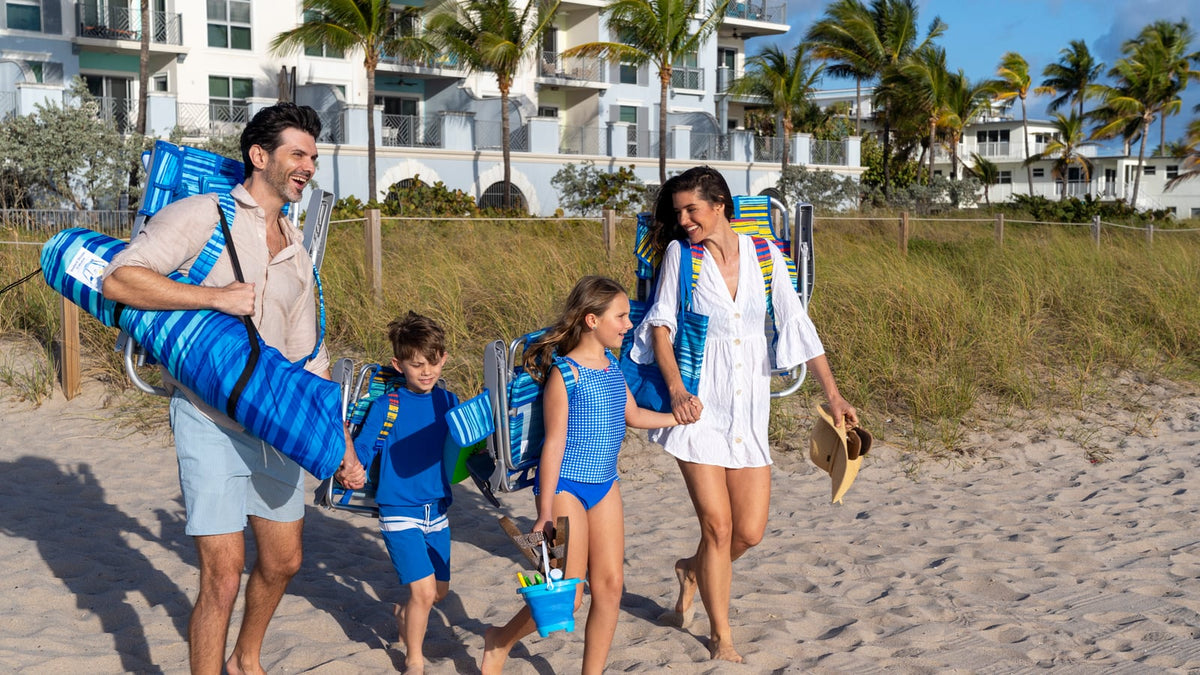
Picture this: you've rented a beach house for a week, three generations are packed into minivans, and everyone lands on the sand at the same time. Grandma needs a low-back chair that won't wreck her knees. The toddler needs shade, NOW. Your brother-in-law forgot chairs entirely. Your teenager wants a recliner. And you're standing there holding two bags, a cooler, and a beach umbrella that keeps popping out of the ground every time the wind picks up. Sound familiar?
Multigenerational beach vacations are some of the most rewarding family experiences you can create, but the logistics can quietly turn a dream trip into a stressful one before anyone even gets their feet wet. The difference between a chaotic beach landing and a genuinely relaxing one comes down to one thing: planning the right gear for every person in your group, in advance, so the beach works for all of you at once.
This guide walks you through every step of planning a multigenerational beach vacation with precision, from assessing each family member's comfort needs to selecting multigenerational beach chairs, building your shade system, coordinating your family beach gear bundle, and executing a packing strategy that doesn't leave anyone behind. Whether your group spans ages two to eighty-two, this is the framework that makes it work.
Step 1: Map Your Group Before You Touch a Single Product Page
Before you buy a single piece of gear or book a single rental, the most important step is the one most families skip entirely: mapping the specific needs of every person in your group. This is the foundation of a successful multigenerational beach setup, and skipping it is how families end up with mismatched gear, uncomfortable elders, and a setup that serves no one particularly well.
Create a Simple Group Roster
Start by listing every person attending and assigning them to a comfort tier. You don't need a spreadsheet (though one doesn't hurt). You just need to answer four questions for each person:
- Mobility: Do they have difficulty getting in and out of low chairs? Are there back, hip, or knee concerns?
- Sun sensitivity: Are there young children, elderly adults, or anyone with fair skin or medical conditions requiring strict shade?
- Activity level: Are they planners who will sit for hours, or will they be in and out of the water constantly?
- Comfort preferences: Do they want to recline? Do they want a footrest? Are they happy sitting upright?
Once you have this picture, you'll immediately see that a single style of beach chair will not serve your whole group. That's not a problem, it's information. The goal isn't uniformity; it's ensuring every member of your group has exactly what they need to stay comfortable for a full beach day.
Identify Your Shade Anchors
Shade is the non-negotiable variable for multigenerational groups. Infants and toddlers cannot regulate their body temperature the way adults can, and the American Academy of Dermatology recommends keeping babies under six months out of direct sunlight entirely. On the other end of the spectrum, older adults and anyone on medication with photosensitivity requirements also need reliable, consistent shade coverage throughout the day.
Note how many people will need guaranteed shade access at any given time. This determines how many shade structures you need and what size. A single small umbrella cannot reliably shade four adults, two kids, and a baby simultaneously, and the frustration of inadequate shade is one of the top reasons multigenerational beach trips end earlier than planned.
Estimate Your Setup Footprint
A group of eight to twelve people needs significantly more real estate on the beach than most first-time planners anticipate. Mentally sketch out your setup: chairs in a semicircle under and around one or two shade structures, with a clear path for anyone with mobility challenges to move between seating and the water. This footprint planning also tells you how many chairs you need, whether you need a secondary umbrella or cabana, and whether a bundled purchase makes more financial and logistical sense than buying items piecemeal.
Step 2: Choose the Right Chairs for Every Age and Body
Selecting the right seating is the single most impactful gear decision you'll make for a multigenerational group. The best beach setup for families isn't one where everyone has the same chair; it's one where each person's chair matches their body, their mobility level, and how they want to spend the day.
Understanding Chair Height and Mobility
Chair height is the most overlooked factor in multigenerational beach seating. Standard low-sling beach chairs sit very close to the ground, which feels great for young adults and teenagers but can be genuinely difficult for older adults with knee or hip issues to lower into or rise from. If your group includes grandparents or any adults with joint concerns, you need to specifically prioritize chairs with a higher seat position.
Copa's beach chair lineup is built with this exact challenge in mind. Their chairs are designed for real-world family use across a wide age range, with seat height and back support engineered to accommodate both the comfort preferences of younger beach-goers and the practical mobility needs of older adults. When evaluating any beach chair for multigenerational use, look for a seat height that allows the user to stand up without needing to roll forward or use their arms to push off the ground.
Reclining Options and Back Support
Multi-position recline is a feature that benefits every age group differently. For teenagers and young adults, it's about sun-lounging comfort. For older adults, a chair that can be positioned slightly upright provides lumbar support that a fully reclined chair doesn't offer. For parents of young children, the ability to sit upright quickly is practical, since you'll be jumping up constantly.
Look for chairs that offer at least three recline positions so each user can find their own sweet spot. A chair that locks reliably in each position, rather than drifting backward under body weight, is worth every extra dollar for a multigenerational group.
Weight Capacity and Durability
For groups that include larger adults or that plan to use gear across multiple seasons, weight capacity is a practical spec worth reading carefully. Budget beach chairs often list a capacity that doesn't account for the stress of repeated use in sand and saltwater. Copa's chairs are built with durability as a core requirement, using materials that hold up to the corrosive beach environment across many seasons rather than just one summer.
The Multigenerational Chair Selection Matrix
| Family Member | Priority Feature | Chair Trait to Look For | Avoid |
|---|---|---|---|
| Grandparents / Older Adults | Easy entry and exit | Higher seat height, firm frame | ❌ Ultra-low sling chairs |
| Parents (30s–50s) | Versatility and quick movement | Multi-position recline, sturdy armrests | ⚠️ Chairs with no upright position |
| Teenagers | Full recline, lounging comfort | Multiple recline angles, portability | ✅ Most beach chairs work well |
| Young Children (5–12) | Lightweight, easy for them to carry | Compact, lightweight, colorful | ⚠️ Heavy adult-sized chairs |
| Toddlers / Infants | Shade, not seating | Parent seated nearby in upright chair | ❌ Independent seating unsupervised |
Step 3: Build a Shade System That Actually Holds
Shade is the cornerstone of any successful multigenerational beach day, and it's the area where most families make their most costly mistake: buying a cheap umbrella that won't stay anchored. On a calm day, almost any umbrella will stand. On a beach day with even moderate wind, the difference between a quality anchoring system and a budget pole stuck in sand becomes immediately, sometimes dangerously, clear.
Why Anchor Technology Matters More Than Umbrella Size
A larger umbrella is only as good as its ability to stay in the ground. An umbrella that tips or flies out of the sand is a safety hazard for everyone around it, not just your group. This is where Copa's patented Anchor Max® technology makes a measurable difference. Rather than relying on a simple pole jammed into loose sand, the Anchor Max® system is engineered to provide deep, stable anchoring that holds even when conditions change during the day. Wind picks up after noon at most coastal beaches, and a shade system that performs at 10 AM needs to still be standing at 3 PM.
The Anchor Max® is specifically designed to be driven deeply and securely into beach sand, creating a stable base that resists the lateral forces wind exerts on an open umbrella canopy. For families with infants and toddlers who will be sitting directly under the umbrella for hours, this isn't a nice-to-have feature; it's the specification that makes the product genuinely safe for that use case.
Sizing Your Shade Coverage for a Multigenerational Group
Shade coverage math is simple but often miscalculated. An umbrella's stated diameter is measured tip to tip across the canopy. The actual ground shade it casts depends on the sun angle, which changes throughout the day. At midday, when the sun is nearly overhead, the shadow footprint of a standard umbrella may cover three or four seated adults comfortably. In the afternoon, as the sun drops and the angle changes, that shadow shifts and elongates, potentially leaving part of your group exposed.
For groups larger than four to five people, plan for two umbrellas positioned to provide overlapping coverage, or consider Copa's cabana options, which offer substantially more square footage of shade in a single structure. A cabana-style setup also provides side shielding from low-angle morning and late-afternoon sun that a vertical-pole umbrella cannot match.
Positioning Your Shade for All-Day Coverage
Set up facing the water with shade structures positioned behind and slightly to one side of your seating cluster. This allows the morning sun to be managed by positioning the umbrella to the east, and gives you room to shift the angle as the sun moves. Always account for the fact that the shadow will move, and ensure your oldest and youngest group members are seated where they will remain in shade for the longest portion of the day without needing to move frequently.
Pro tip: Arrive early. The best beach setup for families relies on securing a good position on the beach before the crowds arrive. An hour earlier than you think you need to be there is the right answer for a large multigenerational group.
Step 4: Choose the Right Family Beach Gear Bundle
Buying beach gear as a coordinated bundle rather than sourcing each item separately solves three problems at once: it ensures everything is compatible and works as a system, it simplifies the purchase process, and it typically delivers better value than buying the same items individually. For multigenerational families, where the gear list is longer and the needs more varied than a couple or a solo traveler, the bundle approach is particularly well suited.
What Makes a Bundle Actually Useful
Not all bundles are created equal. A genuinely useful family beach gear bundle should include shade, seating, and any essential accessories that connect the two into a functional system. A bundle that pairs an umbrella with chairs that don't complement each other in height or style creates more friction, not less. Copa's bundle packages are designed from the ground up to work as coordinated systems: the chairs, shade structures, and accessories are sized, weighted, and styled to complement each other so that setup is intuitive rather than improvisational.
Copa offers the Deluxe Bundle and Essentials Bundle as their primary coordinated package options. The Deluxe Bundle is the right choice for larger multigenerational groups or for families who want the most complete setup possible, including premium shade coverage and full-featured chairs. The Essentials Bundle serves families who want a streamlined, high-quality core setup without additional accessories. Both ship for free, which is a meaningful consideration when you're shipping bulky beach gear to a vacation destination or a coastal home.
Bundle vs. Individual: A Practical Decision Framework
| Scenario | Best Approach | Why |
|---|---|---|
| First-time family beach trip, no existing gear | ✅ Full bundle | Everything works together from day one; no compatibility guesswork |
| Already have chairs, need shade upgrade | ⚠️ Shade-only purchase | Adding Anchor Max® umbrella or cabana to existing setup |
| Multigenerational group of 8+ | ✅ Deluxe Bundle + supplemental chairs | Bundle covers core group; add individual chairs for extras |
| Traveling light, limited car space | ✅ Essentials Bundle | Core setup, compact pack, no excess bulk |
| Gift purchase for beach-loving family | ✅ Bundle | Feels complete and premium; free shipping adds value |
Coordinating Gear Across Multiple Households
One of the unique challenges of multigenerational beach vacations is that gear often comes from multiple households. One family has chairs; another has an umbrella; a third has a cooler. The problem is that gear from different sources rarely coordinates: different heights, different aesthetics, different anchoring systems. When you're trying to create a cohesive, functional setup on the beach, mismatched gear creates real friction.
The cleanest solution is designating one household as the "gear household" for the trip and having everyone else bring consumables (food, sunscreen, towels). This household invests in a complete Copa bundle setup that covers the full group's seating and shade needs. The cost can be split among families, and the gear becomes a shared family asset used on every future trip. For multigenerational families who vacation together regularly, this is one of the best investments you can make as a group.
For more guidance on how to approach this kind of coordinated family setup, Copa's complete family beach setup guide covers the full process in detail.
Step 5: Build Your Multigenerational Packing List
Packing for a multigenerational beach group is an exercise in parallel planning. You're not packing for one profile; you're packing for infants, toddlers, school-age kids, teenagers, adults, and older adults simultaneously, each with their own requirements. The goal is a packing system that ensures nothing critical is forgotten for any age group while avoiding the trap of overpacking to the point where carrying gear to the beach becomes its own ordeal.
The Age-Tiered Packing Approach
Rather than a single master list, use an age-tiered approach. Assign one person per household to be responsible for that household's tier. Here's how to break it down:
Infant and Toddler Tier (0–3 years): This tier requires the most specialized items and the least flexibility. Essentials include shade-rated sun protection (UPF 50+ coverings, not just sunscreen for babies under six months), a portable UV-blocking tent or pop-up shade if you need secondary coverage beyond your umbrella, swim diapers, extra dry clothes, snacks and formula or nursing supplies, a portable changing pad, and a dedicated bag that doesn't get mixed up with the main group supplies.
Young Child Tier (4–10 years): Sun protection remains critical here but kids in this tier are mobile and active. Pack reef-safe sunscreen (required at many protected beach areas), rash guards, water shoes if the beach has rocks, sand toys for independent play, a dedicated small cooler with their snacks and drinks, and a change of dry clothes for the drive home. Their chair, if any, should be lightweight enough that they can carry it themselves, which gives them ownership and reduces the load on adults.
Teen and Young Adult Tier (11–25 years): This group largely self-manages but benefits from being assigned specific gear responsibilities. Give them the chairs, the cooler, or the bags to carry. They have the strength and stamina for it, and giving them a role reduces the overall burden on the adults who are managing younger children and supporting older adults simultaneously.
Adult and Parent Tier (26–65 years): This is the coordination tier. Adults carry the shade structure, manage setup, and handle logistics. Keep their personal load as light as possible so they have capacity to assist others. This is where a well-organized gear bag that contains everything for setup (umbrella, Anchor Max®, chair carry bags, stakes) becomes critical: one bag, one system, no hunting for parts on the beach.
Senior Tier (65+ years): Seniors often need the least packing but the most comfort-specific items. Priorities include their specific chair (pre-selected for ease of entry and exit), extra sun protection (clothing, hat, full-coverage shade), any mobility aids they use, a dedicated spot in the setup that is shaded the longest, easy access to water and food, and a clear path back to the parking lot that doesn't require them to wade through soft sand for long distances if possible.
The Non-Negotiable Items List
Beyond tier-specific items, there is a core non-negotiable list for any multigenerational beach day. These are the items where forgetting one creates a problem for the entire group:
- Reef-safe sunscreen, SPF 50+ (bring more than you think you need)
- A large insulated cooler with ice, water, and electrolyte drinks
- A first aid kit including bandages, antiseptic wipes, and any prescription medications
- A waterproof bag or dry box for phones, keys, and wallets
- Extra towels (one per person plus two spares)
- A beach cart or wagon for groups larger than six, to transport gear from parking to beach
- A phone charging bank for a full-day trip
- Trash bags for a clean, leave-no-trace beach exit
Copa's own ultimate family beach packing list is a useful companion resource for making sure your full group is covered on every item, including accessories that are easy to overlook.
Step 6: Plan Your Beach Setup Sequence
Arriving at the beach with a large multigenerational group without a setup sequence is a recipe for chaos. Someone needs to claim the spot. Someone needs to set up shade before the youngest and oldest members of the group are standing in the sun. Someone needs to keep track of the toddler while gear is being unloaded. A five-minute pre-arrival conversation about setup sequence saves twenty minutes of confusion on the sand.
The Three-Phase Setup Protocol
Phase 1: Claim and Anchor (2–3 minutes). The fastest, strongest adult in your group goes ahead with the shade structure and Anchor Max® anchor system while everyone else is still unloading. Their only job is to find the right spot (enough space, reasonable proximity to water, not directly downwind of anyone else's barbecue or smoking section) and get the umbrella or cabana anchored and open. Shade up first, always. This is the rule that protects infants and older adults from their first minutes of sun exposure while the rest of the setup happens.
Phase 2: Seat the Priority Members (3–5 minutes). Before chairs are arranged for everyone, seat the oldest adults and any infants or toddlers first. This takes them out of standing-in-sun mode and frees the adults managing them to help with the rest of setup. Bring the priority chairs (the higher-seated senior chairs and the parent chair that will face the baby's spot) out of bags first, in the order you'll use them.
Phase 3: Full Group Setup (5–10 minutes). Now everyone else gets chairs arranged, the cooler is placed in shade, the gear bags are organized, and the setup is complete. Assign one teenager or young adult to oversee this phase while the parents with young children are managing kids.
The Beach Cart Investment
For groups of six or more, a beach cart or collapsible wagon is not a luxury; it is a logistical necessity. Making multiple trips between a parking lot and a beach spot with a large group means leaving children unattended on the beach or leaving gear unattended in the lot, neither of which is ideal. A good beach cart allows the entire group's gear to move in one or two trips, which also means the senior members of your group walk to the beach once with a light personal bag rather than making multiple heavy-load trips.
Look for a cart with wide balloon tires or all-terrain wheels, since standard narrow wheels sink in soft sand and make the cart harder to pull than no cart at all. A cart that folds flat and fits in a car trunk is the most practical format for a group that's driving to the beach each day.
Step 7: Address the Comfort Needs That Get Overlooked
The practical gear list and setup sequence will carry you a long way, but multigenerational beach vacations have a second layer of comfort needs that often go unaddressed until someone is already uncomfortable. These are the details that separate a truly relaxing beach day from one where someone checks out early, and they're worth planning for explicitly.
Heat Management for Seniors and Infants
Heat management is the most underestimated comfort issue for multigenerational groups. The CDC's guidance on heat-related illness identifies older adults and infants as two of the highest-risk groups for heat exhaustion and heat stroke, both of which can develop on a hot beach day even with shade. Shade alone is not sufficient if the air temperature is extremely high or if the beach is particularly humid.
Practical additions for heat management include:
- A battery-powered portable fan clipped to the umbrella pole or cabana frame
- A spray bottle filled with water for misting (particularly effective for infants)
- Scheduled "cool breaks" inside an air-conditioned car or beach house every 90 minutes for the youngest and oldest members of the group
- Pre-frozen water bottles that serve as both ice packs and cold drinks as they melt
- Lightweight, loose-fitting UPF clothing for seniors and kids rather than relying solely on sunscreen
Sand Comfort for Mobility-Limited Adults
Sand is a genuinely difficult surface for anyone with balance or mobility challenges. A senior adult who walks confidently on pavement may struggle significantly in soft, uneven sand. There are practical accommodations worth building into your setup:
- Position senior seating at the hardpack sand line where possible (closer to the water, where sand is firmer), rather than in the soft sand zone further up the beach
- If soft sand is unavoidable, place a small section of beach mat or outdoor rug in front of their chair to create a stable standing surface for getting in and out of the seat
- Ensure their chair has wide, sturdy armrests they can push off from when standing
- Have a family member positioned to assist during the stand-up process rather than waiting to be asked
Keeping Teens and Tweens Engaged
A less-discussed but very real challenge of multigenerational beach trips is keeping older children and teenagers genuinely engaged rather than bored and disengaged. Bored teenagers leave the group, wander away, or spend the entire day on their phones, which undermines the multigenerational connection the trip was meant to create.
Build in activities that span age ranges: a group bocce set or paddleball game that everyone from ages eight to sixty can participate in, a snorkeling excursion for the teens while younger kids build sand castles nearby, a shared meal or cookout that gives everyone a role. The beach itself is the activity for younger children; for teenagers, you need to be more intentional about creating experiences that feel worth being present for.
Step 8: Plan Your Beach Departure with the Same Care as Arrival
The departure phase of a multigenerational beach day is where exhaustion, wet gear, hungry children, and tired seniors collide at maximum intensity. A poorly managed departure turns a great day into a grumpy memory. Planning it in advance takes about five minutes and saves a significant amount of friction.
The 30-Minute Wind-Down Protocol
Thirty minutes before your planned departure time, begin the wind-down sequence. This is not when you start packing; it is when you signal the transition to packing so that no one is caught off guard. Children who are mid-sandcastle need a warning, not a sudden "we're leaving now." Seniors who have been sitting for hours need time to stand, stretch, and orient themselves before they start walking to the parking lot.
The actual packing sequence should reverse your setup sequence: younger adults and teenagers break down chairs and fold gear while parents manage children and ensure seniors are comfortable and ready to walk. The shade structure comes down last, maintaining coverage until the group is ready to move.
Sand Management
Sand in gear is the gift that keeps giving, usually into your car, your vacation rental, and eventually your home. Shake out every towel before it goes into the bag. Keep a separate mesh bag for wet swimsuits that can ride on the outside of a bag or in an open trunk compartment. A small hand broom or brush is useful for cleaning sand off feet and legs before loading into a vehicle, which is particularly important when loading senior adults who may struggle to dust themselves off independently.
Copa's gear is designed with this real-world post-beach cleanup in mind: materials that resist sand adhesion and dry quickly mean that chairs and accessories don't arrive home still damp and sandy in a way that requires a full cleaning session before they can be stored.
Step 9: Apply These Principles to Fourth of July and Holiday Beach Days
Holiday beach days add a specific layer of logistical complexity on top of everything covered in steps one through eight. Fourth of July beach trips are among the most crowded beach days of the year at most coastal destinations, and multigenerational groups face unique challenges: limited parking, reduced available beach space, increased sun and heat exposure during midday, and the added variable of evening fireworks that extend the day well beyond the standard beach-day timeline.
For holiday beach days with a multigenerational group, the steps above apply with amplified urgency. Arrive earlier than you think you need to (pre-7 AM at popular beaches for a Fourth of July setup). Secure your shade anchor before the crowds make navigation difficult. Plan a mid-afternoon departure for seniors and infants to a cooler location, with plans to return for the evening festivities. The complete guide to the best beaches for Fourth of July weekend offers additional destination-specific guidance worth reviewing alongside this planning framework.
The Essential Beach Accessories for Families: What to Add After the Basics
Once the core setup (chairs, shade, Anchor Max®, cooler) is in place, a set of supporting beach accessories for families elevates the experience from functional to genuinely enjoyable. These are the items that don't make the must-have list but that families with good setups consistently include.
Beach Towel Clips and Organization Systems
Towels blowing off chairs is one of the small, persistent annoyances of beach days that adds up over a full day with a large group. Weighted or clip-on towel holders attach to chair arms and keep towels in place. For a group with six or more people, this one small addition removes a surprising amount of minor friction from the day.
Portable Table or Tray System
A low portable table or cup holder system that sits between chairs solves the practical problem of where to put drinks, snacks, sunscreen, and phones. On the sand, everything placed on the ground gets sandy, tipped over, or lost. A small surface between chairs keeps the group's essentials accessible and organized without requiring a large, heavy side table.
Sun-Protective Accessories for Seniors
For the oldest members of your group, invest in dedicated sun-protection accessories beyond what the umbrella provides: a wide-brim hat rated UPF 50+, lightweight long-sleeve sun shirts, and UV-blocking sunglasses. These items ensure that even when the umbrella's shadow shifts, the senior members of your group maintain meaningful sun protection without needing to move or interrupt their rest.
Sand-Free Beach Mats
For families with toddlers who spend time on the sand near the chairs, a sand-free beach mat provides a clean surface for sitting, playing, or laying an infant down. These mats allow sand to sift through rather than accumulating on the surface, keeping the play area significantly cleaner and reducing the sand-on-everything problem that plagues standard beach blankets.
Family Beach Day Tips That Actually Make a Difference
The family beach day tips that actually move the needle for multigenerational groups are not the generic ones you'll find on any travel list. They come from real experience managing large groups with diverse needs on the same beach at the same time. These are the insights that separate a smooth day from a stressful one.
Assign a "Setup Captain" for Every Trip
Every beach day should have one designated Setup Captain. This is the person who knows the complete gear list, knows the setup sequence, and is empowered to direct the group during setup and breakdown. Without this role, setup devolves into everyone doing a little bit of everything and nothing getting done efficiently. The Setup Captain isn't doing all the work; they're coordinating the work. This role can rotate between trips so it doesn't always fall to the same person.
Pre-Assign Gear to Households Before Every Trip
The night before a multigenerational beach day, send a simple group message assigning each household their gear responsibilities. Household A brings the Copa bundle (chairs, umbrella, Anchor Max®). Household B brings the cooler and food. Household C brings the kids' supplies and beach toys. Household D brings the towels and the beach cart. When everyone knows their assignment, nothing gets doubled up and nothing gets forgotten.
Create a Shared Location Pin for Rendezvous
On a crowded beach with a large group, people who step away to get food, use restrooms, or walk along the shore can struggle to find the group again. Drop a GPS pin at your beach setup location in a shared group text the moment you're set up. This eliminates the "I can't find you" phone calls and allows teenagers and young adults to move independently without the group needing to track them constantly.
Set Sun and Hydration Reminders
On a beach day, it is genuinely easy to lose track of time under the sound of waves and the rhythm of a good day. Set repeating phone reminders for sunscreen reapplication every 90 minutes and for water check-ins every 30 minutes. These reminders are particularly important for children, who will not self-report thirst until they are already mildly dehydrated, and for older adults, who may not feel thirsty even when their hydration is compromised.
Build in a "Quiet Hour" for Mixed-Energy Groups
Multigenerational groups have wildly different energy levels. By mid-afternoon, infants will need to nap, seniors will want to rest quietly, and teenagers will be at peak energy. Rather than fighting these natural rhythms, plan for a quiet hour in the mid-afternoon where the high-energy members of the group move to the water or to a separate activity, leaving the rest zone near the shade setup calm and restful. This coordination means everyone gets what they need without conflict, and the whole group is recharged for the late-afternoon hours.
Frequently Asked Questions About Multigenerational Beach Vacations
How many beach chairs do I need for a multigenerational group?
Plan for one chair per adult and older teen, plus any specialty chairs for seniors. Young children often share adult laps or play on the sand rather than occupying a chair for the whole day, but having one or two compact kids' chairs available is helpful for snack and rest times. For a group of eight adults and three children, eight adult chairs and two compact children's chairs is a reasonable baseline.
What is the Anchor Max® and why does it matter for family beach setups?
The Anchor Max® is Copa's patented umbrella anchoring system, designed to provide deep, stable anchoring in beach sand even in windy conditions. For families with infants, toddlers, or seniors who depend on continuous shade coverage, a secure anchor system is a safety feature as much as a convenience. Standard umbrellas inserted shallowly into sand can tip or fly in moderate wind, creating a hazard for anyone nearby. The Anchor Max® is engineered to eliminate that risk.
What's the difference between Copa's Deluxe Bundle and Essentials Bundle?
Copa's Essentials Bundle provides a complete core beach setup with premium chairs and shade coverage suited for smaller families or those who want a streamlined system. The Deluxe Bundle adds more comprehensive features, additional accessories, and greater overall capacity, making it the right choice for larger multigenerational groups or those who want the most complete setup available. Both bundles ship for free, which is a meaningful saving on bulky beach gear.
How do I accommodate a grandparent with mobility challenges on the beach?
Prioritize a chair with a higher seat height and firm armrests for easy entry and exit. Position their chair at the hardpack sand line near the water where possible, since firmer sand is significantly easier to walk on. Place a small beach mat in front of their chair for a stable standing surface. Consider a beach cart to eliminate the need for them to carry anything to the beach. Have a family member positioned nearby during seating and standing to offer assistance without waiting to be asked.
How early should we arrive at the beach on a holiday weekend?
For major holidays like Fourth of July, Memorial Day, or Labor Day, arriving before 8 AM is strongly recommended at popular beaches. The best spots (shade-friendly, near facilities, not too close to high-traffic areas) fill quickly. A multigenerational group with a complete setup benefits disproportionately from a good position, since you're anchoring shade structures and arranging seating for many people rather than just laying out a towel.
How do I keep infants safe in the heat at the beach?
The American Academy of Pediatrics recommends keeping infants under six months out of direct sunlight entirely and limiting older babies' sun exposure during peak hours (10 AM to 4 PM). Use a shade umbrella with the Anchor Max® for stable coverage, supplement with a UV-blocking pop-up tent if needed, keep the infant in lightweight, full-coverage clothing, mist regularly with water, and take cool-environment breaks every 60–90 minutes on hot days.
What beach accessories are most important for families with toddlers?
The highest-priority accessories for toddler families are reliable shade (umbrella with secure anchor), a sand-free beach mat for a clean play surface, reef-safe sunscreen, rash guards, swim diapers, a dedicated snack cooler with cold water and easy-open containers, and a dry bag for changes of clothes. Everything else is supplemental. The Anchor Max® umbrella system is the single most important gear item for toddler families because continuous, reliable shade is non-negotiable for this age group.
Is it worth buying a beach gear bundle instead of renting gear at the beach?
For families who beach vacation more than twice a year, buying a quality bundle almost always delivers better long-term value than renting, particularly given the quality differential. Rental gear at beach concessions is typically lower quality, often poorly maintained, and provides no guarantee of availability on busy days. A Copa bundle ships to your home or vacation destination and provides premium-quality gear that performs reliably across many seasons. The free shipping on Copa bundles further reduces the cost gap between buying and renting.
How do I manage sunscreen reapplication for a large multigenerational group?
Designate one person per household as the sunscreen lead for their family unit. Set a group reminder on a shared phone or ask a teenager to manage the timer. Keep sunscreen in a dedicated, easily accessible pouch attached to one of the chairs or the umbrella pole rather than buried in a bag. Plan for at least 90-minute reapplication cycles for everyone and more frequent checks on children who have been in the water, since swimming significantly reduces sunscreen effectiveness even with water-resistant formulas.
What's the best way to divide the gear load for a large group arriving in multiple cars?
Designate gear categories to specific vehicles. The largest vehicle carries the shade structure, chairs, and beach cart. A second vehicle carries the cooler and food supplies. Smaller vehicles carry personal bags and towels. This prevents any one vehicle from being overloaded and ensures that the setup gear arrives together rather than being split across cars that might arrive at different times. Pre-load gear the night before rather than the morning of departure to reduce stress and time pressure.
Can Copa's products be shipped to a beach rental property for a vacation?
Yes, and this is actually one of the most practical use cases for Copa's free shipping bundles. Order gear to arrive at your vacation rental address a day before the group arrives, so the first morning is a beach morning rather than a gear-shopping morning. Confirm the rental property's delivery acceptance policy in advance, and ensure someone in the group has the tracking information so the delivery can be monitored.
How do I handle the beach logistics when different family groups arrive at different times?
Assign one early-arriving household the full setup responsibility. They carry and set up the complete Copa bundle (shade, chairs, Anchor Max® anchor) and hold the space for the group. Share the GPS pin of the setup location in the group chat immediately after setup is complete. Late-arriving members can walk directly to the spot without needing to navigate by description. Assign the late-arriving households the consumables (food, drinks) so the early-arriving household isn't burdened with the full gear load.
Key Takeaways
- Map your group before buying anything. Understanding the mobility, sun sensitivity, and comfort needs of every family member is the prerequisite for all gear decisions in a multigenerational beach setup.
- Shade is the foundation. The Anchor Max® anchoring system is what makes shade reliable rather than aspirational. For groups with infants and seniors, a secure, stable umbrella or cabana is a safety requirement, not a preference.
- Chair selection is age-specific. Senior adults need higher-seat chairs for mobility. Parents need upright versatility. Teenagers and young adults benefit from recline options. One chair style will not serve all three.
- A family beach gear bundle eliminates compatibility problems. Copa's Deluxe and Essentials Bundles are designed as coordinated systems, meaning every component works with every other component from day one. Free shipping makes the bundle approach even more practical.
- Packing by age tier ensures nothing critical is forgotten. Assign tier responsibility by household rather than building one single master list that no one person manages.
- Assign roles. A Setup Captain, gear assignments per household, and a pre-arrival sequence conversation turn a chaotic beach arrival into a smooth, fast setup that has the whole group comfortable within minutes.
- Plan the departure as carefully as the arrival. A 30-minute wind-down protocol, reverse setup sequence, and sand management strategy protect the good mood of the day all the way to the parking lot.
- Small accessories make a measurable difference. Towel clips, portable tables, sand-free mats, and battery fans are the details that turn a functional setup into a genuinely comfortable one for a full beach day.
A multigenerational beach vacation works when every person in the group, from the youngest to the oldest, has exactly what they need to be comfortable from the moment the umbrella goes up to the moment the last chair goes back in the bag. That outcome isn't accidental; it's the result of the kind of planning this guide outlines. For families who make beach days a regular part of their shared life together, investing in the right gear and the right system pays dividends every single time you hit the sand.
For more ideas on creating memorable beach days across generations, explore Copa's Beach Tips blog, where the full library of family-focused beach planning guides continues to grow.
Shop Now
Learn more →
Share:
Beach Bundle vs. Buying Separately: An Honest Cost and Convenience Breakdown
Ergonomics on the Beach: What Makes a Chair Actually Comfortable for Long Days