

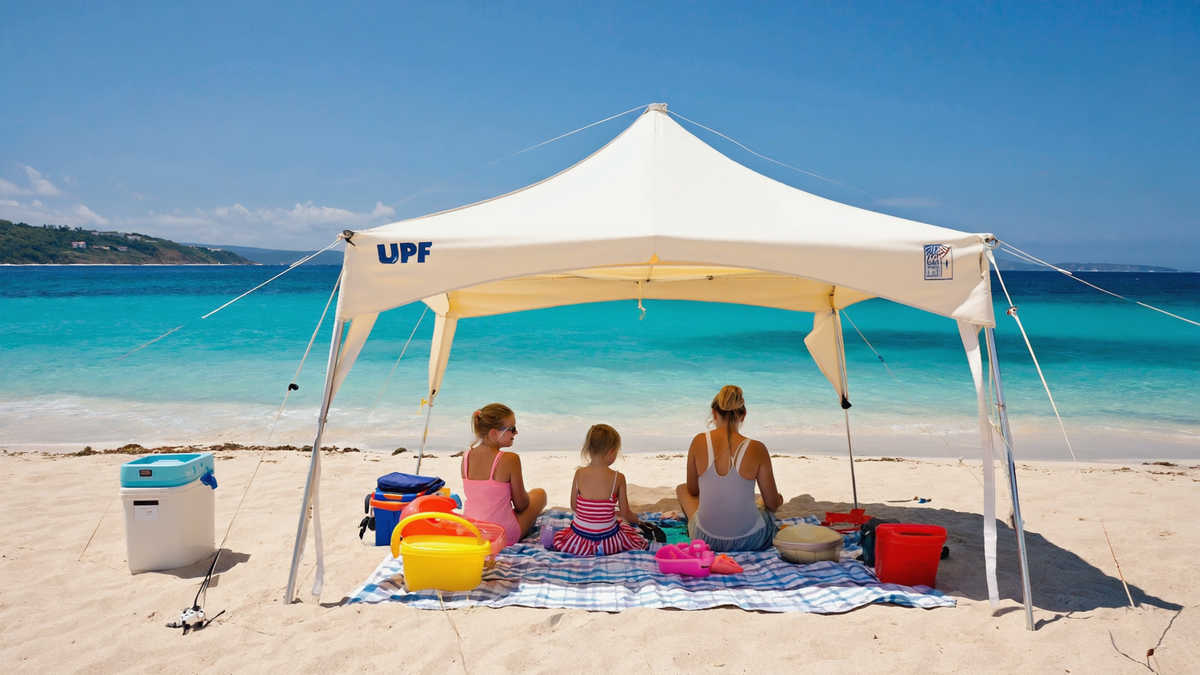
Most sun protection advice for beach trips stops at "apply sunscreen and reapply every two hours." That guidance is not wrong, but it addresses only one layer of a genuinely complex problem. Sunscreen alone, even when applied correctly and generously, cannot replicate the protection that physical shade provides. For families with young children, that gap between "we brought sunscreen" and "we actually kept our kids safe" can mean the difference between a great beach day and a painful, exhausted evening dealing with burned shoulders and overtired toddlers.
The science behind this is straightforward: the EPA confirms that UV radiation is the primary environmental cause of skin damage, and physical shade structures reduce UV exposure far more reliably than chemical filters applied to skin alone. Yet the default setup at most family beach outings still involves a single standard umbrella planted in the sand, which shifts with the sun, catches wind, and leaves half the family squinting into direct light by midday.
This guide is a comprehensive framework for building a genuinely sun-safe beach day from the ground up, covering the mechanics of UV exposure, the real-world performance of different shade structures, how to use timing as a sun-protection tool, and how the right gear choices work together as a system rather than a collection of independent purchases.
Why Sunscreen Is Not Enough: Understanding UV Exposure at the Beach
Physical shade, not sunscreen, is the most effective single intervention for reducing UV exposure at the beach. That statement sounds obvious, but the implications are underappreciated by most families planning a beach day. Understanding why requires a quick look at how UV radiation actually behaves in a coastal environment.
At the beach, UV radiation arrives from three directions simultaneously. Direct radiation comes straight from the sun. Reflected radiation bounces off the sand and water, meaning that even sitting under a standard umbrella does not eliminate exposure from below and at angles. Scattered radiation diffuses through the atmosphere and reaches you from all directions, including on overcast days when the sky feels bright but not sunny. This combination is why beachgoers often burn more severely than they expect, particularly when clouds give a false sense of protection.
Sand is a particularly effective UV reflector. The World Health Organization notes that surfaces like sand and water can reflect up to 25 percent of UV radiation, compounding exposure beyond what direct sunlight alone would deliver. For children playing low to the ground, this reflected UV hits their faces and bodies at close range, making shade coverage from below just as important as coverage from above.
The Sunscreen Application Gap
Sunscreen is a genuine tool, but its real-world effectiveness depends on application thickness and consistency that most people do not achieve. Dermatological guidance recommends applying approximately one ounce of sunscreen to cover an adult body fully, which is considerably more than most people use in practice. For children who are running, swimming, sweating, and rolling in sand, maintaining that coverage throughout a full beach day requires vigilance that competes with the entire point of a relaxing family outing.
This is not an argument against sunscreen. It is an argument for understanding sunscreen as a secondary layer of protection, not the primary one. The primary layer should always be physical: shade structures, UPF-rated clothing, and strategic timing. Sunscreen fills the gaps that physical protection cannot cover, particularly on exposed skin when children are in the water or moving beyond the shade footprint.
Children and UV Sensitivity
Children's skin produces melanin less efficiently than adult skin, which means their natural UV defense is genuinely lower. Infants under six months should avoid direct sun exposure entirely, according to the American Academy of Pediatrics. For toddlers and young children, the combination of sensitive skin, high activity levels, and the time typically spent at the beach makes physical shade the non-negotiable baseline, not an optional upgrade.
What this means practically: before you think about which sunscreen to pack, think about where your family will be sitting, how much shade that spot provides, and whether your shade structure will remain effective as the sun moves across the sky over a four-to-six hour beach day.
Reading the Sun: How Timing Changes Everything
The single most underutilized sun-protection tool for families at the beach is the clock. UV intensity is not constant throughout the day, and structuring your beach schedule around UV peaks is a more powerful intervention than most gear purchases.
UV Index, the standardized measurement of UV radiation intensity, peaks between 10 AM and 4 PM in most US coastal locations during summer months. Within that window, the two hours on either side of solar noon (typically around 1 PM in daylight saving time) represent the highest-risk period. A family that arrives at the beach at 8 AM and leaves by noon has spent most of their time in genuinely lower-risk conditions, even without significant shade infrastructure. A family that arrives at 11 AM and stays until 4 PM has spent their entire visit in peak UV conditions.
The Morning-First Strategy
Experienced beachgoing families often independently arrive at the same strategy: go early, stay through late morning, break for lunch and the hottest part of the afternoon, then return in the late afternoon if desired. This approach aligns beach time with the hours when UV intensity is naturally lower, when sand is cooler for bare feet, and when the beach is typically less crowded.
For families with young children, the afternoon break also aligns naturally with nap schedules, making it a logistically sound approach beyond just sun safety. The late-afternoon return, if the family chooses it, happens during the post-peak UV window when the light is warm and golden but less intense, which many parents find is also the most enjoyable time of day aesthetically.
Using the UV Index as a Planning Tool
The EPA's UV Index scale runs from 0 to 11+, with values above 6 classified as High or Very High. Most US coastal locations during summer regularly reach UV Index values of 8-10 between 11 AM and 2 PM. Free UV Index forecasts are available through the National Weather Service and through standard weather apps. Checking the UV forecast the night before a beach day and planning departure times around it is a simple habit that meaningfully reduces cumulative UV exposure without requiring any additional gear or cost.
The practical implication: even with excellent shade infrastructure, understanding and respecting the UV Index makes your shade strategy significantly more effective. Shade at 9 AM is a comfort enhancement. Shade at noon is a health necessity.
Beach Shade Solutions: What Actually Works and What Doesn't
Not all beach shade structures perform equally, and the differences matter significantly for families who need reliable, lasting coverage across a full beach day. The most common failure mode for standard beach umbrellas is not the product itself but the mismatch between what families expect and what the product actually delivers.
A standard beach umbrella provides a shade footprint that moves with the sun. Set up correctly at 9 AM, it may provide excellent coverage for two chairs. By 11 AM, as the sun shifts, the shade footprint has rotated and the coverage has changed. By 1 PM, without repositioning, the umbrella may be shading the sand beside your chair while you sit in direct sunlight. This is not a design flaw; it is the nature of a single-pole shade structure. But it requires active management that most families are not prepared to provide consistently throughout a full day.
The Case for Beach Cabanas and Shade Tents
A beach cabana or UPF beach shade tent solves the footprint problem structurally. Instead of projecting shade from a single point above, a cabana creates an enclosed or semi-enclosed shade environment with walls and a roof. The shade it provides is largely independent of sun angle, meaning a family set up inside a well-designed cabana at 9 AM is still meaningfully protected at 1 PM without anyone having to adjust or reposition the structure.
The UPF rating of a shade fabric matters here. UPF (Ultraviolet Protection Factor) measures how much UV radiation a fabric blocks. A UPF 50 rating means the fabric blocks approximately 98 percent of UV radiation passing through it. For a beach cabana to function as genuine sun protection rather than just visual shade, the fabric needs a meaningful UPF rating. Thin or unrated fabrics can create a visual shadow while still transmitting significant UV, which creates a false sense of security particularly dangerous for children.
Copa's beach cabana products are built with sun protection as a design priority, not an afterthought. The structure is engineered for families who need dependable coverage that holds up through a full beach day, not just the first hour after setup.
Stability: The Problem Nobody Talks About Until It Happens
Any beach shade structure is only as good as its ability to stay where you put it. At the beach, two forces work against stability: wind and loose sand. A shade structure that collapses or blows over is not just an inconvenience; it is a safety hazard, particularly for young children, and it defeats the entire purpose of the protection it was supposed to provide.
Standard beach umbrellas typically use a single pole pushed into the sand, which provides reasonable stability in calm conditions but can become dangerously unstable in even moderate coastal winds. Cabanas and shade tents vary enormously in how they address the anchoring problem, with many relying on sandbag pockets or simple pole-into-sand insertion that offers marginal improvement over a standard umbrella.
Copa's shade products are built around a patented anchoring system that goes significantly beyond standard designs. The Anchor Max® technology is Copa's engineered solution to beach anchoring, designed to secure shade structures firmly in loose sand even in challenging coastal wind conditions. Rather than relying on the weight of sand poured into a pocket or the friction of a thin pole in loose ground, the Anchor Max® system is purpose-built for the specific physics of wet and dry sand, providing a stable foundation that holds through the shifting conditions of a real beach day.
For families with young children, the importance of this cannot be overstated. A shade structure that requires constant monitoring or repositioning to prevent collapse is one that takes parental attention away from watching children. A structure that stays put through wind gusts and shifting conditions is one that works quietly in the background, doing its job while the family does what they came to the beach to do.
Comparing Shade Structure Options: A Practical Framework
| Shade Structure Type | Coverage Consistency | Wind Stability | UPF Fabric Options | Best For |
|---|---|---|---|---|
| Standard Beach Umbrella | ⚠️ Requires repositioning as sun moves | ⚠️ Moderate, depends on pole depth | ⚠️ Varies by brand | Short beach visits, low-wind days |
| Pop-Up Shade Tent | ✅ Consistent regardless of sun angle | ⚠️ Variable, often relies on sandbag pockets | ✅ Often rated UPF 50+ | Families with infants and toddlers |
| Beach Cabana (Standard) | ✅ Enclosed coverage, consistent all day | ⚠️ Depends heavily on anchoring method | ✅ Generally high UPF rated | Full-day family beach sessions |
| Beach Cabana with Anchor Max® System | ✅ Consistent, all-day coverage | ✅ Engineered anchoring for coastal sand | ✅ Purpose-built UV protection fabric | Families needing reliable, hands-free sun protection |
Sun Protection at the Beach for Kids: A Layer-by-Layer Approach
Effective sun protection at the beach for kids is not a single product decision. It is a layered system where each element addresses the gaps left by the others. The most sun-safe beach days for families are built on at least four distinct layers working together, and understanding each layer helps parents make smarter decisions about where to invest their attention and their budget.
Layer One: Physical Shade Structure
As established above, this is the foundation. A quality beach cabana with genuine UPF-rated fabric and stable anchoring creates the protected home base from which everything else operates. Children at rest, eating, napping, or playing in the sand immediately around the base camp should be inside or directly under the shade structure. This is the layer that requires the most upfront gear investment but provides the most consistent, passive protection throughout the day.
Layer Two: UPF Clothing
For children who are active at the beach, UPF-rated swimwear and rash guards are among the most underutilized tools available. A UPF 50+ rash guard covering a child's shoulders, back, and arms eliminates sunscreen application on those areas entirely, which is a meaningful simplification for parents managing multiple children. Modern UPF swimwear is lightweight, comfortable, and widely available in children's sizes. Many families find that pairing a rash guard with swim shorts or a swimsuit bottom removes the most difficult areas to apply sunscreen reliably (the back and shoulders) from the equation altogether.
Wide-brim hats that shade the face, ears, and back of the neck add another critical coverage zone. Children playing in shallow water or building sandcastles are often looking down, which points the back of their neck directly at the sun. A hat with a full brim addresses this without requiring any reapplication or adjustment throughout the day.
Layer Three: Sunscreen on Exposed Skin
With shade and UPF clothing handling the majority of the body, sunscreen becomes a more targeted application covering the remaining exposed skin: face, hands, lower legs, and feet. This targeted approach is more reliably executed than trying to cover an entire body, and it means reapplication is more likely to happen consistently because it is less overwhelming.
Mineral sunscreens (zinc oxide and titanium dioxide based) sit on top of the skin and begin working immediately upon application, which makes them particularly practical for children who may enter the water quickly after being prepared. Broad-spectrum SPF 30 or higher is the standard recommendation, with SPF 50 commonly chosen for children's products.
Layer Four: Hydration and Heat Management
UV radiation causes sunburn, but heat causes exhaustion, dehydration, and heat-related illness that can escalate faster than parents expect, particularly in young children. Physical shade reduces not only UV exposure but also heat load, making the base camp meaningfully cooler than the surrounding open beach. This is a benefit of shade structures that rarely appears in product descriptions but matters significantly for how long and how comfortably a family can sustain a beach day.
Cold water, electrolyte drinks for older children, and shaded rest periods between active play sessions are the behavioral practices that complete the protection system. A well-hydrated child in the shade recovering from a swim run is a child who can safely continue the beach day for another two hours. A dehydrated, overheated child who has been in continuous sun is a child who needs to leave regardless of how well the sunscreen was applied.
Building Your Family's Beach Base Camp: Gear That Works as a System
One of the most common mistakes families make when assembling beach gear is buying individual items without considering how they interact as a system. A beach chair that sits too low makes it impossible to watch active toddlers effectively. A shade umbrella positioned too far from the chairs means nobody actually sits in the shade. A cooler that is too large to carry easily gets left in the car, which means no cold water when children need it most.
The most functional family beach setups treat gear as an integrated system with a defined home base, clear zones for different activities, and equipment that is genuinely portable enough to be used rather than left behind.
The Home Base Principle
Every family beach day needs a clearly defined home base: a fixed point that children can return to, that adults can see from the waterline, and that provides shade, seating, and access to supplies. For families with young children, this base should be visible from the water so that parents in the surf can maintain visual contact with younger siblings who are playing in the sand under supervision near the base.
The shade structure defines the home base. Everything else radiates from it: chairs positioned at the perimeter of the shade footprint, cooler accessible from any chair, bags and towels stored in a consistent location so nothing gets lost in the sand. This structure reduces the cognitive load of managing a beach day with multiple children significantly, because everyone knows where home is.
Copa's Bundled Approach to Beach Setup
Copa's design philosophy addresses the system problem directly. Rather than selling individual items that families must figure out how to combine, Copa offers curated bundle packages, including the Deluxe Bundle and Essentials Bundle, that are engineered to work together. The chairs, the shade structure, and the accessories are selected to complement each other in terms of portability, setup compatibility, and aesthetic coherence.
For families building their beach kit from scratch, or upgrading from mismatched gear accumulated over several seasons, this bundled approach eliminates the compatibility guesswork. The chairs are sized and designed to fit within the shade footprint of the cabana. The carrying solutions are matched to the weight and dimensions of the components. Everything sets up together in a predictable, repeatable process that gets faster each time the family uses it.
Copa's premium beach chairs are engineered for multigenerational comfort, which matters in practice because a grandparent who cannot comfortably get in and out of a low-slung beach chair will not use it, which means they will not be comfortably positioned in the shade where they need to be. Chair height, armrest design, and weight capacity are not afterthoughts in Copa's design process; they are functional requirements for the families the brand actually serves.
For a comprehensive overview of how to structure a complete family beach setup, the complete beach setup guide for families on Copa's blog covers the spatial and logistical dimensions of building a beach base camp that actually functions under real conditions.
Portability: The Hidden Gear Selection Criterion
Every piece of beach gear that a family owns is only as useful as its likelihood of actually making it to the beach. This sounds obvious, but it explains one of the most common patterns in beach gear: families own heavy, cumbersome equipment that they gradually stop bringing because the effort of transport outweighs the benefit. The shade tent that weighs 18 pounds gets left home after the second trip. The cooler that needs two adults to carry eventually stays in the car. The chairs that require a separate cart to move get replaced by lighter, cheaper alternatives that are less comfortable but actually make the journey.
Copa's product design prioritizes the full journey: not just beach performance, but the carry from the car to the sand and back. Lightweight materials, compact storage configurations, and integrated carrying solutions are part of the design brief, not optional features. For families managing gear alongside strollers, beach bags, and children, the difference between a shade structure that one adult can carry in one trip and one that requires two adults and a separate cart is the difference between gear that gets used and gear that does not.
What to Look for in a Beach Cabana: A Buyer's Framework
The beach cabana market has expanded considerably as families have recognized the limitations of standard umbrellas, and the range of quality and performance across available products is significant. Families evaluating beach cabana options for sun protection should assess several specific attributes rather than relying on general quality signals like brand recognition or price point alone.
UPF Rating: What the Numbers Mean
A beach cabana marketed as "sun protection" without a specific UPF rating should be treated with skepticism. UPF ratings are testable, verifiable specifications. A fabric rated UPF 50 blocks approximately 98 percent of UV radiation; a fabric rated UPF 30 blocks approximately 97 percent. The practical difference between these two ratings is small, but the difference between a rated fabric and an unrated one can be significant in terms of actual UV transmission.
Look for products that specify both the UPF rating and whether the rating applies to the canopy fabric only or to all panels of the cabana. Open-weave side panels that are not UV-rated can allow significant UV transmission from the side and below, which is particularly relevant for the reflected UV from sand that affects children playing low to the ground.
Ventilation: The Comfort Factor That Affects Usability
A beach cabana that creates full shade but traps heat will not be used by active families for extended periods. Mesh ventilation panels in the upper sections of a cabana allow hot air to escape while maintaining shade coverage, creating a meaningfully cooler interior environment. This is not just a comfort feature; it is a usability feature. A shade structure that the family actually stays inside for the hottest hours of the day provides vastly more UV protection than a shade structure they abandon because it is uncomfortably hot.
Setup Time and Complexity
At the beach with children, setup time is not a minor inconvenience. It is the window during which children are unsupervised and in direct sunlight while adults are occupied with poles and stakes. A cabana that sets up in under five minutes, with a clear and repeatable process, is functionally different from one that takes fifteen minutes and requires consulting instructions. The first gets used; the second generates resentment.
Copa's cabana designs are optimized for real-world family setup conditions: the kind where one adult may be doing most of the setup while the other manages children who have already spotted the water and want to go immediately. Fast, intuitive assembly is not a marketing point; it is a functional requirement for the target user.
Anchoring System Performance
Return to the anchoring question, because it is the most consequential structural specification for beach shade. A cabana that provides excellent shade but is vulnerable to coastal wind is a liability. Beach winds are unpredictable and can shift quickly; a shade structure that tips or collapses in a wind gust near children playing in sand is a safety event, not just an inconvenience.
The Anchor Max® system incorporated into Copa's shade products represents a meaningful engineering investment in solving this problem. Rather than treating anchoring as an afterthought, Copa has developed a patented approach that accounts for the specific challenges of beach sand: loose texture, variable moisture content from tidal zones, and the lateral force of wind on a large fabric surface. The result is a shade structure that stays where it is placed through the kind of variable coastal conditions that are the norm rather than the exception at real beaches.
Sun Safety Beyond the Shade Structure: Habits That Multiply Protection
Gear provides the infrastructure for sun safety, but the behavioral habits that families develop around that gear determine whether the protection is actually effective. The most common failure mode for even well-equipped families is the gap between having the right gear and consistently using it correctly throughout a full beach day.
The Sunscreen Timing Problem
Chemical sunscreens require approximately 15-20 minutes to bind to skin and become effective, which means applying sunscreen at the water's edge after arriving at the beach is providing minimal protection for the first critical window of exposure. The practical habit that addresses this: apply sunscreen before leaving the house or hotel, not at the beach. This ensures the product is active from the moment of sun exposure, eliminates the chaos of trying to apply sunscreen to excited children at the beach, and reduces the sand contamination problem that makes beachside sunscreen application so ineffective.
The Shade Migration Pattern
As the sun moves throughout a beach day, even a well-positioned shade cabana will have zones of better and worse coverage at different hours. Families who understand this adjust their positioning within and around the shade structure as the day progresses, moving chairs and play areas to track the optimal shade zone. This is a habit, not a complicated task, but it requires awareness of sun position that most families do not develop consciously.
A simple version of this: designate someone in the family as the "shade manager" who checks coverage at the top of every hour and adjusts chair positions or shade orientation as needed. In practice, this takes about 60 seconds per check and ensures that the family's shade infrastructure is actually providing coverage throughout the day rather than just when they first set up.
Water Play and UV Exposure
Children in the water are among the most UV-exposed individuals on the beach, for several reasons. The water's surface reflects UV radiation upward onto faces and shoulders from below. Water cools the sensation of heat, removing the discomfort signal that would otherwise prompt children to seek shade. And the activity of playing in the surf is highly absorbing, meaning children (and parents) lose track of time in ways they would not if sitting in chairs.
Practical strategies: set a timer for water play sessions, with a defined return-to-shade interval. UPF rash guards worn in the water eliminate the need to apply and reapply sunscreen on covered areas. Sunscreen on faces and necks specifically should be reapplied immediately after water sessions, not after drying off and settling back into chairs, because the UV exposure during water time is when faces are most exposed.
Recognizing Heat Stress in Children
Young children do not reliably self-report heat stress before it becomes a medical concern. Fussiness, reduced activity, unusual quietness, and flushed skin are early indicators that a child needs to return to shade, drink water, and rest. Families with multiple children under age five should build in mandatory shade breaks rather than waiting for children to request them, because the request often comes too late to prevent significant discomfort.
The shade base camp serves a function here beyond UV protection: it is the recovery zone that makes extended beach days sustainable. A child who spends 20 minutes in shade drinking water and eating a snack is usually ready to return to the water refreshed. A child who does not get that break may need to end the beach day entirely, which affects the entire family's experience.
Packing for a Sun-Safe Beach Day: The Essential Gear Checklist
Building a sun-safe family beach day requires bringing the right items, but it also requires being selective enough that the gear is actually portable and usable. The following framework organizes essentials by category, with the rationale for each item.
For a complete packing reference, Copa's ultimate family beach packing list provides a comprehensive breakdown of everything families need for a full day at the shore, including category-by-category organization that makes the pre-trip preparation process significantly more systematic.
| Category | Essential Items | Sun-Safety Priority | Notes |
|---|---|---|---|
| Shade Infrastructure | Beach cabana or UPF shade tent, Anchor Max® anchoring system | ⭐⭐⭐ Critical | Non-negotiable for full-day beach visits with children |
| Seating | Premium beach chairs sized for all family members, beach mat for children | ⭐⭐ High | Chairs that keep adults positioned within shade footprint |
| Sun Protection Clothing | UPF rash guards for all children, wide-brim hats, UV-protective sunglasses | ⭐⭐⭐ Critical | Covers shoulders and back, reducing sunscreen dependency |
| Sunscreen | Broad-spectrum SPF 50+, mineral formula for children, lip balm with SPF | ⭐⭐ High | Apply before leaving home; reapply every 90-120 minutes |
| Hydration | Insulated water bottles, electrolyte drinks, cold water in cooler | ⭐⭐⭐ Critical | Children need proactive hydration prompts, not just on-demand access |
| Snacks | High-water-content fruits, protein-based snacks, avoid sugar-heavy options in heat | ⭐ Moderate | Eating in shade creates natural break intervals |
| First Aid | After-sun gel, basic first aid kit, children's pain reliever | ⭐ Moderate | Prevention-focused day rarely requires use, but critical when needed |
Fourth of July and Holiday Beach Days: Sun Safety Under Peak Conditions
Holiday beach days, particularly summer holiday weekends, present a compounded sun-safety challenge. UV intensity in late June and early July is at its annual peak in most US coastal regions. Beaches are significantly more crowded, which reduces available shade spots, creates more competition for prime positioning, and often means families arrive later (and stay later) than on a typical weekday visit. And the festive, celebratory atmosphere of a holiday beach day naturally reduces the vigilance families bring to sun-safety habits.
For families planning major summer beach outings, the planning framework from this guide applies with heightened urgency. Arriving early to secure a good position and set up shade infrastructure before the beach fills up is not just a comfort consideration; it is the strategy that allows the family to maintain their base camp through the peak UV hours without being pushed into direct sun by overcrowding.
Copa's blog covers the specific considerations for holiday beach planning in detail, including destination selection and timing strategies, in the guide to the best beaches for Fourth of July weekend, which includes practical advice from experienced beachgoers on navigating crowded beach conditions while maintaining a quality family experience.
The core principle for holiday beach days: the same sun-safety framework applies, but every element of it needs to be executed more deliberately and with more lead time. Sunscreen applied before leaving the house is even more important when the beach is crowded and a private moment to apply it does not exist. Shade infrastructure that sets up quickly matters more when arriving in a crowd. And the timing strategy of morning beach visits followed by afternoon breaks becomes even more valuable when late-afternoon beach conditions are at their most intense and most crowded simultaneously.
The Long View: Building Sun-Safe Habits That Last
The most effective sun protection for children is not a product or a piece of gear. It is the habits that families build around sun safety, which become automatic over time and require decreasing active effort to maintain. Gear supports these habits by making the protective choice the convenient choice: a shade cabana that is genuinely easy to set up gets used every trip; one that is complicated gets left home. Sunscreen that is pre-applied before leaving home becomes routine; sunscreen that requires hunting through a bag at the beach gets applied inconsistently.
Families who build sun-safe beach habits with young children are establishing patterns that carry forward as children age. A child who grows up understanding that shade is the home base, that rash guards are normal beach attire, and that sunscreen is applied before you can see the water will carry those habits into adolescence and adulthood with significantly less friction than a child for whom sun protection was always a negotiation or a battle.
The gear investment that Copa represents is therefore not just about this summer's beach days. It is about the infrastructure around which a family's beach culture develops. The stories families tell about their beach days, the memories that make up a child's experience of summer, are shaped by how comfortable, safe, and effortless those days feel. A beach day where parents are constantly anxious about sunburn, chasing an umbrella that blew over, or managing a child who is overheated and miserable is not a memory anyone wants to carry forward.
Copa's founding story is rooted in exactly this understanding: that beach days are worth doing well, and that the right equipment, thoughtfully designed and properly used, transforms the experience for everyone. The Copa Beach Tips blog is built around this philosophy, providing families with the knowledge and frameworks they need to make every beach day genuinely excellent.
Frequently Asked Questions: Sun-Safe Beach Days for Families
What is the most effective beach shade solution for families with young children?
A beach cabana with a verified UPF 50+ fabric rating and a reliable anchoring system provides the most consistent, all-day shade coverage for families with young children. Unlike standard umbrellas, a cabana creates an enclosed shade environment that does not require repositioning as the sun moves, and its enclosed design provides protection from reflected UV radiation from sand and water as well as direct overhead sun.
What does UPF mean on a beach shade tent, and why does it matter?
UPF stands for Ultraviolet Protection Factor, and it measures how much UV radiation a fabric blocks. A UPF 50 rating means the fabric blocks approximately 98 percent of UV radiation passing through it. For a beach shade tent to provide genuine sun protection rather than just visual shadow, the fabric must carry a meaningful UPF rating. Unrated fabrics can transmit significant UV even when they appear to be blocking light.
How often should sunscreen be reapplied during a beach day?
Broad-spectrum sunscreen should be reapplied every 90-120 minutes during active sun exposure, and immediately after swimming or heavy sweating. The practical approach for families is to set a recurring reminder on a phone and treat reapplication as a non-negotiable interval task rather than a reactive response to visible redness. For children, apply sunscreen before leaving home so it is already active upon arrival at the beach.
What hours should families try to avoid direct sun exposure at the beach?
UV radiation intensity peaks between 10 AM and 4 PM, with the highest-risk window typically between 11 AM and 2 PM. Families can significantly reduce cumulative UV exposure by scheduling morning beach visits that end before or at noon, then returning in the late afternoon if desired. Checking the daily UV Index forecast (available through the National Weather Service or standard weather apps) provides location-specific guidance for planning.
Is a beach umbrella sufficient for sun protection, or do families need a full cabana?
A standard beach umbrella provides useful shade but requires active repositioning as the sun moves and offers limited protection from reflected UV radiation from sand and water at ground level. For families planning full-day beach visits with young children, a beach cabana provides meaningfully more consistent and comprehensive protection. Umbrellas are more appropriate for shorter visits or as supplemental shade alongside a primary cabana structure.
What is the Anchor Max® system and why does it matter for beach shade?
The Anchor Max® is Copa's patented anchoring technology, engineered specifically for the challenges of loose coastal sand. It provides a stable, secure foundation for shade structures that holds through variable wind conditions, going significantly beyond standard pole-in-sand or sandbag-pocket anchoring approaches. For families with young children, a shade structure that stays firmly in place eliminates a safety hazard and removes the need for constant monitoring of the structure's stability throughout the day.
What should children wear at the beach for maximum sun protection?
The most protective combination for children at the beach is a UPF 50+ rash guard covering the shoulders, back, and arms, paired with UPF-rated swim bottoms or shorts, a wide-brim hat that covers the face, ears, and back of the neck, and UV-protective sunglasses. This combination eliminates the need to apply and reapply sunscreen on covered areas, making the overall protection system significantly more consistent in practice.
How do I keep my family in the shade when children want to be active?
The goal of shade infrastructure is not to keep children stationary but to provide a protected home base they return to regularly. Building structured shade breaks into the beach day, timed around snacks, water, and rest periods, creates natural return-to-shade intervals that even active children accept more readily than open-ended shade requirements. Setting a timer for water play sessions and requiring a shade break between water sessions is a practical structure that most families find workable with children over age three.
Can I rely on cloud cover for sun protection at the beach?
Cloud cover provides minimal UV protection. Thin cloud cover can transmit 80-90 percent of UV radiation, and the UV Index on a bright overcast day can remain in the high-risk range. Many significant sunburns occur on partly cloudy beach days precisely because the absence of direct sunlight creates a false sense of safety. Physical shade structures and sunscreen remain necessary regardless of cloud conditions.
What is the difference between UPF clothing and SPF sunscreen?
UPF measures fabric UV blocking; SPF measures sunscreen UV filtering. Both use different measurement protocols but the fundamental difference is that UPF clothing provides consistent, fixed-level protection that does not wash off, sweat off, or require reapplication, while sunscreen protection degrades with time and activity. For beach use, UPF clothing on covered areas is more reliably protective than sunscreen applied to the same areas, making it the preferred choice for children's shoulders, back, and arms.
How do I choose between Copa's Essentials Bundle and Deluxe Bundle for a family beach day?
The right bundle depends on group size and how often your family beaches. The Essentials Bundle provides a solid foundation for smaller families or less frequent beach visits. The Deluxe Bundle is designed for larger groups, multigenerational outings, or families who want a comprehensive gear system that handles a full day at the shore without requiring supplemental purchases. Both bundles include components engineered to work together as an integrated system, which simplifies setup and ensures gear compatibility.
How early should families arrive at the beach to secure good shade positioning?
On popular beaches during summer weekends, arriving by 8:30-9 AM is generally necessary to secure a desirable position with good shade potential. For major holiday weekends, including Fourth of July, arriving by 8 AM or earlier is advisable. Beyond UV considerations, early arrival allows setup time before children are impatient, secures proximity to the waterline appropriate for the children's ages, and provides the morning low-UV-intensity window before the peak hours begin.
Key Takeaways: Building a Sun-Safe Beach Day That Actually Works
- Physical shade is the foundation, not the supplement. A quality beach cabana with UPF-rated fabric provides more consistent UV protection than sunscreen alone, because it is passive, continuous, and not subject to the application gaps that affect chemical sunscreen in real-world conditions.
- The Anchor Max® system matters for safety, not just convenience. A shade structure that blows over in coastal wind is a hazard. Copa's patented anchoring technology is engineered for the specific physics of beach sand, providing genuine stability through variable conditions.
- Timing is a free sun-protection tool that most families underuse. Scheduling beach visits around the UV Index, with arrival before 10 AM and breaks during the 11 AM-2 PM peak window, significantly reduces cumulative UV exposure without requiring any additional gear.
- Sun protection at the beach for kids works best as a layered system: shade structure first, UPF clothing second, targeted sunscreen on exposed skin third, with hydration and rest as the behavioral layer that makes everything sustainable.
- Gear portability determines gear usability. A shade structure or chair that is too heavy or cumbersome to carry easily will gradually stop making the trip to the beach. Copa's design philosophy addresses the full journey, from car to sand, not just the beach performance of each product.
- Bundled gear systems eliminate compatibility guesswork. Copa's Deluxe and Essentials Bundles provide coordinated, complementary beach gear that is designed to work together, simplifying the buying process and ensuring that chairs, shade structure, and accessories function as an integrated system.
- Habits built around sun-safe beach days compound over time. Children who grow up with shade-first beach culture, UPF clothing as normal beach attire, and proactive hydration as routine carry those habits forward, making sun safety an automatic part of outdoor life rather than a constant negotiation.
- Holiday beach days require the same framework with greater urgency. Peak UV intensity, larger crowds, and later arrival times on holiday weekends make every element of the sun-safety system more important, not less. Plan and execute the framework more deliberately, not more casually, on high-stakes beach days.
Shop Now
Learn more →
Share:
Beach Gear Bundles Explained: How Coordinated Systems Save Families Time, Money, and Setup Stress
How to Choose Between a Beach Bundle and Individual Gear Pieces for Your Family's Exact Setup