

It happened on a Tuesday afternoon in late July, somewhere between the third sunscreen application and the second juice box. A family had finally gotten settled, chairs unfolded, towels spread, snacks distributed, when a gust of wind peeled their beach umbrella clean off its pole and sent it cartwheeling across the sand toward a crowded shoreline. Nobody was hurt. But the afternoon was over. The umbrella was bent, a stranger's cooler had taken a hit, and two kids under five were now crying in direct sunlight while their parents tried to apologize and repack everything at the same time.
This is not a rare story. Anyone who has spent serious time at the beach with a family knows that the umbrella is the single most important piece of gear they bring, and the single most likely to fail at the worst possible moment. And yet, for decades, umbrella anchoring technology received almost no engineering attention. You pushed a spike into the sand. You hoped for the best. The umbrella either stayed put or it didn't, and the wind made that decision for you.
That calculus has changed. The rise of patented beach umbrella anchor systems has fundamentally shifted how families approach shade at the beach, and understanding what separates a real anchor system from a decorative spike is one of the most valuable things a beach-going parent can know. This article goes deep on the mechanics, the physics, the failure modes, and the specific engineering that makes a modern beach umbrella anchor system genuinely different from everything that came before it.
Why Standard Spike Anchors Fail in Soft Sand
A traditional beach umbrella anchor is essentially a sharpened rod, sometimes with a corkscrew tip, that you push or twist into the sand. In firm, compacted soil, this works reasonably well. At the beach, it is almost always inadequate. Here is why, and why the failure is predictable rather than random.
Sand is not a solid medium. It is a collection of loose, dry granules with very little cohesive bonding between them. When you insert a spike into dry beach sand, you are not locking it into a rigid substrate, you are displacing granules that immediately want to flow back around the intrusion. The spike sits in a channel of disturbed, loosely packed material. Any lateral force applied to the top of the umbrella pole translates directly into leverage against that loosely packed column, and the physics are not favorable.
The Lever Arm Problem
Consider the geometry. A typical beach umbrella stands six to eight feet tall. The anchor penetrates perhaps twelve to eighteen inches into the sand. When wind catches the canopy, it generates a lateral force at the top of that pole. That force is amplified by the full length of the pole acting as a lever arm against the tiny fulcrum point where the spike meets the sand surface. The higher above the sand the wind force is applied (i.e., the taller the umbrella), the more rotational torque is generated at the base. A six-foot pole with eighteen inches of anchor depth creates a mechanical disadvantage ratio that means even modest wind gusts can produce enough torque to extract the spike entirely.
This is not mainly a materials problem or a product quality problem. It is a geometry problem. A narrow spike in loose sand is at a structural disadvantage against a sustained lateral force, because the contact surface area between the spike and the sand is small relative to the rotational moment a full-sized canopy can generate.
How Dry Sand Compounds the Issue
Wet sand closer to the waterline compacts more easily and provides slightly better resistance. But most families do not set up directly at the waterline, they set back far enough to avoid wave wash, which puts them squarely in the driest, loosest sand on the beach. Securing a beach umbrella in sandy conditions that are dry and loose is categorically harder than anchoring in firmer substrates, and most traditional spike designs were never tested in those conditions with any rigor.
Dry sand also shifts with foot traffic, wind, and heat. An umbrella that feels secure at 10:00 AM may be sitting in increasingly disturbed, loosened sand by 2:00 PM, especially if kids are digging nearby or the area has seen heavy foot traffic. The anchor that felt adequate when first installed progressively loses holding power throughout the day, often without any visible warning to the family sitting underneath.
Wind Is Not Steady, and That Matters
Sustained moderate wind is actually less dangerous than gusting wind, because sustained force allows gradual repositioning rather than sudden extraction. Wind gusts, the sharp, sudden increases in speed that characterize most coastal conditions, produce impulse forces that spike far above the umbrella's average wind load. A spike that holds adequately in 15 mph sustained wind may be completely extracted by a single 30 mph gust lasting two seconds. Traditional anchors have no mechanism to absorb that impulse energy. They either hold or they don't, and the failure mode is instantaneous and violent.
This is the core engineering challenge that patented beach umbrella anchor technology was designed to solve: not just holding under steady conditions, but remaining secure through the variable, unpredictable wind profile that characterizes real coastal environments.
What Patented Anchor Technology Actually Changes
When a company invests in patent protection for an anchoring system, it signals that the engineering is genuinely novel, that something about the mechanism differs meaningfully from prior art. Understanding what that novelty consists of is essential to evaluating whether the technology delivers real-world benefit or is primarily a marketing claim.
Copa's Anchor Max® system represents a purpose-built approach to the problem outlined above. Rather than relying on a narrow spike's friction against loose sand, the Anchor Max® is engineered to create a fundamentally different type of mechanical engagement with the sand substrate. The distinction matters enormously in practice.
Surface Area as the Primary Design Variable
The critical insight behind effective beach umbrella anchoring is that resistance to extraction increases with how much sand the anchor engages. A narrow spike has minimal surface area in contact with sand. A wider, more geometrically complex anchor engages considerably more sand mass. When wind tries to pull or rotate an umbrella out of the ground, it is working against the sand engaged by the anchor. More engaged sand generally means more resistance, which means higher holding power under the same wind load.
This principle is borrowed directly from civil engineering, it is the same reason that a screw anchor for a fence post is more effective than a driven spike, and why foundation pilings are designed with textured or flanged surfaces rather than smooth rods. Applying this principle to a consumer beach product required engineering the anchor geometry to maximize sand contact while still being practical for families to install and remove without tools.
The Rotation Mechanism
One common approach in a beach umbrella anchor system is rotational installation. Rather than driving the anchor straight down (which simply displaces sand in a narrow column), a screw-style or twist-action anchor is rotated into the sand. This does two things simultaneously: it compacts the sand laterally as the anchor threads through it, creating a denser zone of engagement around the anchor body, and it creates a mechanical interlock between the anchor geometry and the surrounding sand that resists not just vertical extraction but also the rotational and lateral forces that wind actually generates.
The Anchor Max® takes a different route to the same goal: instead of a screw, it uses a base that is buried in the sand and holds the pole. The result is a beach umbrella that won't fly away not because it is heavier or harder to set up, but because it is held in the sand in a mechanically meaningful way rather than simply resting in a disturbed channel.
Stability Under Dynamic Loading
The most sophisticated aspect of advanced anchor technology is how it handles dynamic loading, the sudden, variable forces generated by gusting wind. A properly designed anchor system distributes impulse forces across a larger volume of sand, rather than concentrating them at a single contact point. This distribution means that any single gust must overcome the combined resistance of a much larger sand mass before the umbrella can move, which dramatically raises the threshold at which failure occurs.
For families, this translates directly into confidence. Not the tentative confidence of "I think this will hold," but the genuine confidence that allows you to actually relax under your umbrella instead of watching it nervously every time the wind picks up.
The Physics of Wind Load on Beach Umbrellas
To fully appreciate why anchoring is the defining feature of any family beach umbrella, it helps to understand what wind actually does to a canopy and why the forces involved are so much larger than most people intuitively expect.
Canopy Area and Drag Force
A standard beach umbrella canopy is roughly seven to eight feet in diameter, giving it a projected area of approximately 38 to 50 square feet facing the wind. Drag force on a surface is proportional to the square of wind speed, meaning that when wind speed doubles, drag force quadruples. At 20 mph, a large beach umbrella canopy can experience meaningful lateral force. At 40 mph, a wind speed that is not uncommon in coastal thunderstorm conditions, that force is four times greater.
These forces are transmitted entirely through the pole to the anchor point. Every pound of drag force at the canopy becomes leverage against the anchor, amplified by the pole length. This is why umbrella failures in gusting conditions can be so sudden and so dramatic: the forces involved are genuinely large, and they arrive with very little warning.
Why Tilt Increases Risk
Many beach umbrella users tilt their canopy toward the sun to maximize shade coverage. This is completely reasonable behavior, but it significantly changes the wind load profile. A tilted canopy presents a larger projected area to certain wind directions and also introduces asymmetric loading into the pole and anchor system. Traditional spike anchors handle symmetric vertical loading (straight downward pull) reasonably well. They handle asymmetric lateral loading, which is what a tilted canopy in a crosswind actually generates, very poorly.
A properly engineered beach umbrella anchor system must perform under tilted conditions because that is how families actually use their umbrellas. Designing and testing for worst-case tilted-canopy wind loading is a hallmark of serious anchor engineering, and it is one of the areas where patented systems genuinely distinguish themselves from commodity alternatives.
The Consequence of Failure
This is worth stating plainly, because the stakes are higher than a ruined afternoon. A beach umbrella that becomes airborne is a genuine safety hazard. A seven-pound umbrella traveling at speed with a sharpened spike attached represents a serious projectile risk. The U.S. Consumer Product Safety Commission estimates there were 2,800 beach umbrella-related injuries treated in emergency departments from 2010 through 2018. Families deserve equipment that treats this risk seriously rather than treating it as an acceptable outcome of "normal" beach conditions.
What to Look for in a Family-Grade Anchor System
Not all anchor systems marketed as "secure" or "wind-resistant" deliver equivalent performance. Evaluating an anchor system requires looking at specific design characteristics rather than taking marketing language at face value. The following framework helps families make an informed assessment.
| Anchor Feature | Why It Matters | Traditional Spike | Patented Anchor Max® |
|---|---|---|---|
| Sand contact surface area | More area = higher holding force against extraction | ❌ Minimal | ✅ Maximized by design |
| Rotational installation | Compacts sand laterally, creates mechanical interlock | ⚠️ Push-in or simple twist-in | ➖ Not needed: a buried, sand-filled base does the holding |
| Asymmetric load handling | Performs when umbrella is tilted at an angle | ⚠️ Poor | ✅ Engineered for tilted use |
| Impulse force absorption | Distributes gust energy across larger sand volume | ❌ Concentrates force at one point | ✅ Distributed resistance |
| Dry sand performance | Holds in the loosest, driest sand families actually use | ⚠️ Requires compacted sand | ✅ Designed for dry beach conditions |
| Tool-free installation | Practical for families without specialized equipment | ✅ Push in by hand | ✅ No special tools: just the included shovel |
| Patent protection | Signals genuine engineering novelty | ❌ Generic design | ✅ Patented technology |
The Usability Question
An anchor system that requires significant physical effort, specialized tools, or a complex multi-step process creates its own failure mode: families simply do not use it correctly. The engineering challenge is to maximize holding power while keeping installation accessible to any adult. Copa's Anchor Max® was developed with this constraint in mind: it comes with its own shovel and sets up in a few simple steps, so families are more likely to install it correctly.
This is a subtle but important point. The best anchor technology in the world is useless if it is so inconvenient that users skip proper installation. Design for real-world use, not laboratory conditions.
How the Anchor Max® System Works in Practice
Understanding the Anchor Max® specifically requires looking at how it works as a base rather than a spike. Instead of a narrow rod pushed into the sand, it is a dedicated umbrella base that is buried in the sand and holds the pole securely, and Copa designs it to be compatible with all beach umbrellas.
The Buried-Base Principle
When wind tries to pull the umbrella straight up and out, it has to lift the base and the sand buried on top of it, not just overcome friction along a narrow spike. When wind tries to tilt the umbrella sideways, the buried base resists across a much wider footprint than a single pole. The result is far more stable than relying on simple friction against a spike.
Setup in Real Time
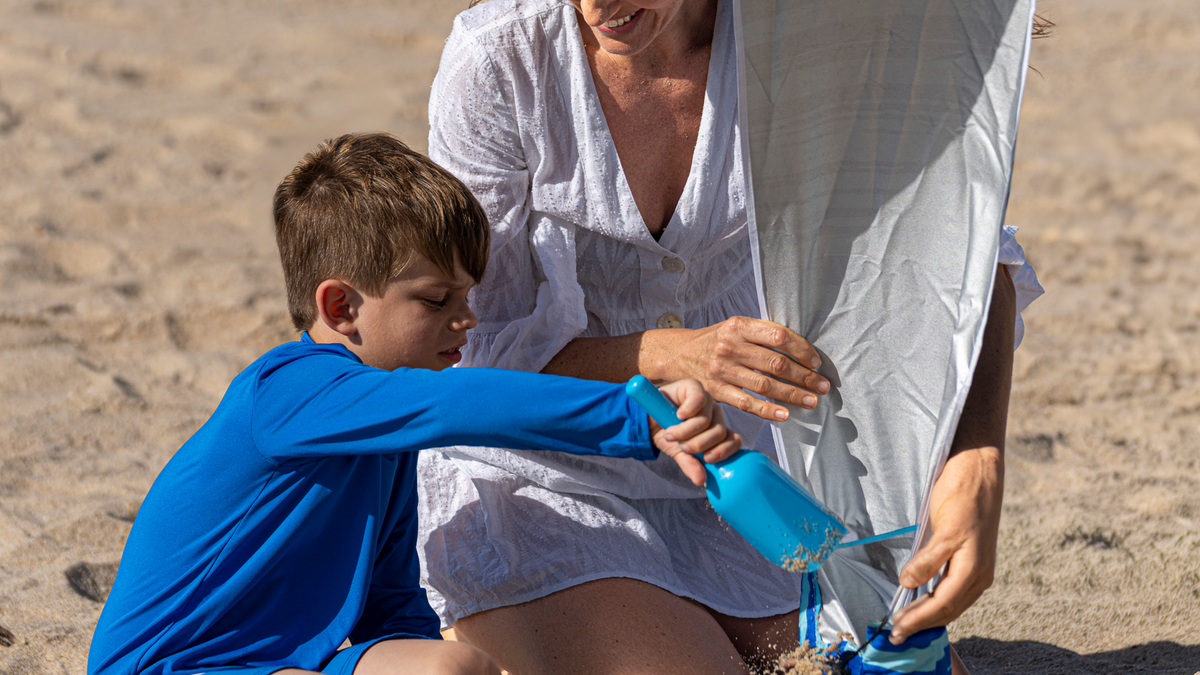
In practical terms, setting up the Anchor Max® is straightforward and requires no unusual physical strength. You use the included shovel to dig a hole matching the base width, set the base in, bury it with sand, insert the umbrella pole and tighten, then open the canopy. The process is designed to be manageable by one adult while handling children, beach bags, and all the other simultaneous demands of a family beach arrival.
This is a meaningful quality-of-life improvement over systems that require two people to install, a mallet to drive in, or a specific sequence of steps that is easy to get wrong under distraction. For families with young children, simplicity is not a convenience feature, it is a safety feature, because a complicated installation process is a process that will sometimes be skipped or done incorrectly.
Removal and Reuse
A good anchor system also needs to be removable without excessive effort at the end of a long beach day, when energy is low and everyone is ready to leave. The Anchor Max® is designed to be set up and taken down by one adult; follow the instructions for your product to remove it cleanly. This matters more than most buyers realize until they have tried to extract a deeply embedded anchor from compacted wet sand after a full day of use.
Why the Anchor Is More Important Than the Canopy
Most beach umbrella marketing focuses on the canopy: UPF rating, size, color, ventilation design, spoke count. These are all legitimate considerations. But the canopy is essentially inert, it does not fail in any meaningful way under normal use conditions. A quality canopy will provide its rated UV protection whether or not it is securely anchored. The anchor, by contrast, is the system component that either succeeds or fails in real time, and its failure has immediate physical consequences.
This means that two umbrellas with identical canopy specifications can deliver completely different real-world experiences based solely on their anchor systems. A premium canopy on a poor anchor is a premium canopy that will eventually be rolling down the beach. An adequate canopy on a superior anchor system is an umbrella you can actually trust.
The Insurance Value of Good Anchoring
Think of the anchor system as the insurance policy for the entire beach setup. The canopy provides the value you are there for, shade, UV protection, a comfortable space for your family. The anchor protects that investment and, more importantly, protects the people sitting under it. A beach umbrella that fails in wind is not just inconvenient; it is a projectile. The anchor system is what stands between your family and that outcome.
From this perspective, the anchor technology is not a secondary feature, it is the primary safety system. Every other feature of a family beach umbrella is secondary to the question of whether it will stay in the ground when the wind comes up.
Long-Term Durability of Anchor Components
Anchor components are subject to repeated stress cycles, installation, wind loading, removal, reinstallation, across many uses. The materials and construction quality of the anchor matter enormously for long-term reliability. A polymer anchor that develops micro-cracks after a season of use may look identical to a fresh anchor but provide significantly reduced holding power. A metal anchor with inadequate corrosion protection will degrade rapidly in the salt-air environment of coastal beaches.
Copa's Anchor Max® is constructed with marine-environment durability in mind, recognizing that beach gear faces a uniquely hostile combination of UV exposure, salt air, abrasive sand, and repeated mechanical stress. The materials selection reflects the reality that a family beach umbrella is not a single-use item, it is a piece of gear that should provide reliable performance across multiple seasons.
Anchor Systems and Beachfront Regulations
This is an angle that very few beach umbrella discussions address, but it is relevant for families who frequent managed beaches. Injuries from wind-blown umbrellas have drawn attention from safety regulators and standards bodies, and some beaches have their own rules about securing or taking down umbrellas in wind. Knowing the landscape helps families choose equipment that holds up to these expectations.
Current Regulatory Trends
The clearest recent development is not a beach rule but a safety standard: in 2024, ASTM International published ASTM F3681, a voluntary consumer safety specification for beach umbrellas and anchor devices that tests whether an anchor stays secured in the sand in wind. Local rules are different. Some beach patrols can ask visitors to take down or remove umbrellas that are not adequately secured, especially in high wind, but requirements vary widely by location and are enforced inconsistently. Check the rules for the beach you plan to visit.
Families investing in quality beach gear should choose equipment designed to meet reasonable holding standards, not just to protect their family but to ensure their setup remains compliant with beach rules that may change from season to season. A patented beach umbrella anchor system that delivers genuine mechanical holding power is the obvious choice in this environment.
Liability and Responsibility
Beyond formal regulations, there is a straightforward personal responsibility dimension to beach umbrella anchoring. If your umbrella becomes airborne and injures another beachgoer, the question of whether you took reasonable steps to secure it becomes relevant. Using equipment designed for secure anchoring, installing it correctly, and taking the umbrella down when the wind picks up are all sensible ways to show you took care. Using a generic spike in conditions where it is known to be inadequate is a different story.
This is not meant to be alarmist, the vast majority of beach days pass without incident. But families who think seriously about risk will recognize that the anchor system is the single component most directly connected to the safety of others around them, not just their own family.
Choosing the Right Copa Shade Solution for Your Family
Understanding the engineering of the Anchor Max® system is most useful in the context of choosing the right Copa product for your family's specific beach habits and group composition. Copa offers several shade configurations built around the same anchor technology, and the right choice depends on factors including group size, beach frequency, and how much shade coverage you need.
Umbrella vs. Cabana: A Coverage Comparison
A traditional beach umbrella provides overhead shade for a defined area, typically enough for two to four people when positioned carefully. It is lightweight, packs compactly, and sets up quickly. For a couple with one or two young children, a quality umbrella with the Anchor Max® system provides excellent coverage with maximum portability.
A beach cabana or sun shelter provides dramatically more coverage, full overhead shade plus side wall protection, making it significantly better for larger groups, extended beach stays, or situations where consistent shade is critical (such as families with infants, toddlers, or anyone with significant sun sensitivity). The trade-off is somewhat larger pack size and slightly more setup time, and because the anchoring setup can vary by product, check the product specifications for how each shade structure is secured.
For families planning a complete beach setup, Copa's bundled packages allow you to combine shade solutions with seating in a single coordinated purchase, ensuring that everything works together as a system rather than assembling mismatched gear from multiple sources.
Bundle Purchasing and System Cohesion
One of the underappreciated advantages of purchasing shade and seating from the same brand is that the components are designed to work together. When your umbrella and chairs come from the same product ecosystem, the shade footprint is calculated to cover the seating arrangement, the color coordination is intentional rather than accidental, and the storage and transport solutions are sized for the complete package.
Copa's Deluxe and Essentials Bundles take this principle seriously, offering coordinated combinations of shade and seating that eliminate the guesswork of assembling a beach setup from scratch. For families preparing for a dedicated beach vacation or looking to upgrade their entire beach kit, a bundle purchase is often the more cost-effective and logistically simpler choice. Free shipping on bundles makes the value proposition even clearer.
Planning for Different Beach Scenarios
The right shade solution also depends on the specific beaches you frequent. Beaches known for strong afternoon winds require higher holding performance than sheltered coves. Beaches with very fine, dry sand present a more challenging anchoring environment than beaches with coarser, naturally compacting sand. If your family regularly visits exposed Atlantic or Gulf Coast beaches, the kind where afternoon sea breezes are a reliable feature of every summer day, the engineering quality of your anchor system should be weighted heavily in your purchasing decision.
For families planning beach vacations to popular destinations, it is worth checking local conditions and beach rules before you go, then choosing gear suited to the wind and sand you expect.
Installation Best Practices That Maximize Anchor Performance
Even the best anchor technology performs better when installed correctly. The Anchor Max® is designed to be straightforward, but a few installation habits make a meaningful difference in holding performance, particularly in challenging conditions.
Choosing Your Spot
Anchor performance varies with sand conditions, so spot selection matters. Avoid areas with visibly disturbed sand from previous umbrella placements, the sand in these areas has already been loosened and displaced, providing a worse starting substrate for your anchor. If possible, choose a spot where the sand has been relatively undisturbed, away from heavy foot traffic and areas that have been repeatedly dug up and sifted.
Avoid positioning your umbrella near the base of sand dunes or in areas where the wind is channeled between other structures, these locations experience accelerated and turbulent airflow that generates higher loads than open beach conditions. Similarly, avoid positions where your umbrella would be directly downwind of larger structures (like rental equipment stacks or buildings) that can create unpredictable wind shadows and gusts.
Depth and Burial
Deeper installation is generally better, up to the design limits of the anchor. For the Anchor Max®, following the installation guidance for your specific product ensures you achieve the designed holding depth. Rushing the installation and stopping short of the recommended depth reduces your holding capacity significantly, the anchor geometry is designed to work at a specific depth, and partial installation provides partial performance.
Take your time burying the base. Dig the hole to the full depth, set the base level, then backfill and firmly pack the sand on top of and around it. Loosely piled sand leaves voids that make the base easier to lift or tilt, so a well-packed fill helps it hold.
Monitor Conditions Throughout the Day
Even a perfectly installed anchor benefits from periodic monitoring, particularly on days when wind conditions change. If wind picks up significantly from when you first set up, check that the anchor has not shifted and that the pole is still seated correctly. If you have adjusted the tilt of your umbrella during the day, the load profile on the anchor has changed, and it is worth a quick check to confirm everything remains secure.
This is not a commentary on any anchor system's reliability, it is simply good beach practice. Conditions change, and the five seconds it takes to give your anchor a quick check is worthwhile. To put together a complete family beach setup, you can browse Copa's full range of chairs and shade.
The Hidden Costs of Cheap Anchor Systems
Budget beach umbrellas are almost universally compromised on anchor design, and the true cost of that compromise is rarely visible at the point of purchase. Understanding the full lifecycle cost of a cheap anchor system helps families make better purchasing decisions.
Replacement Frequency
A beach umbrella that fails mechanically, whether through anchor failure, canopy damage from uncontrolled flight, or structural damage from a hard landing, needs to be replaced. Families who buy a new budget umbrella every season are not saving money compared to families who invest in a quality system that lasts multiple seasons. The per-use cost of a quality umbrella with a durable anchor system is often lower than the per-use cost of cheap alternatives that require frequent replacement.
The Afternoon Cost
When an umbrella fails on a beach day, the day is effectively over, or at minimum, significantly degraded. For a family that has driven an hour to the beach, paid for parking, packed and hauled a full day's worth of gear, and allocated a precious weekend day to the outing, an umbrella failure is a significant cost even if no one is physically injured. Multiply this by the statistical likelihood of failure across multiple seasons of use with an inadequate anchor system, and the expected cost becomes meaningful.
The Safety Premium
There is also a safety premium that is difficult to quantify but genuinely real. The peace of mind that comes from knowing your family's shade solution is anchored by a patented, purpose-engineered system has value independent of any specific incident avoided. Families who choose quality anchor systems are not paranoid, they are rational, because the downside risk of a failed umbrella is real and the cost of prevention is modest relative to the cost of the outcome they are preventing.
Frequently Asked Questions About Beach Umbrella Anchor Systems
What makes the Anchor Max® different from a regular corkscrew anchor?
How deep does the Anchor Max® need to be installed?
The base should be buried to the depth recommended in Copa's product documentation for your specific model. Generally, a deeper, well-packed burial provides more holding capacity, and it is worth taking the additional time to dig to the recommended depth rather than stopping short.
Can the Anchor Max® work in both wet and dry sand?
Yes. The system is designed to perform across the range of sand conditions families actually encounter at the beach, including the dry, loose sand that is the most common failure mode for traditional spike anchors. Wet sand generally provides slightly higher holding capacity than dry sand for any anchor design, but the Anchor Max® is specifically engineered to deliver secure performance in dry conditions where spike anchors typically fail.
Is it difficult to remove the anchor after a beach day?
The Anchor Max® is designed to be set up and taken down by one adult. Because it is a buried base, removal generally means clearing the sand from on top of it, using the included shovel if needed, and lifting it out; follow the instructions for your product. This is an important practical consideration, a good anchor system needs to be manageable at the end of the day, not just easy to install at the beginning.
Do beach regulations require a specific type of anchor?
Regulations vary significantly by location. Some beaches and local governments have adopted or proposed rules on umbrellas and anchoring; others have no formal requirements. Separately, a voluntary U.S. safety standard for beach umbrellas and anchor devices, ASTM F3681, is now in place, and the U.S. Consumer Product Safety Commission advises shoppers to look for a label on the anchor showing it meets that standard. Check your local beach rules before you go, and choose an anchor system designed for genuine holding performance.
What wind speeds can a properly anchored Copa umbrella withstand?
Copa provides performance specifications for its products on love-copa.com. As a general principle, any beach umbrella should be taken down in conditions that exceed its design wind load, including storm conditions, thunderstorm approaches, or sustained high wind events. No anchor system is a substitute for judgment about conditions.
Does the anchor system work for beach cabanas as well as umbrellas?
Copa's anchor technology is integrated into its shade product lineup, which includes both umbrella and cabana configurations. The specific anchor implementation may vary by product, so reviewing the product specifications on love-copa.com will give you the most accurate picture for the specific shade solution you are considering.
How does a family with young children handle the installation without help?
The Anchor Max® system is designed so that one adult can set it up. You dig with the included shovel, bury the base, insert and tighten the pole, and open the canopy. That matters because in many beach families one adult handles setup while the other looks after the children. If you find installation significantly challenging, reviewing the installation guidance on Copa's website will help ensure you are using the correct technique.
Is the anchor system covered under Copa's product warranty?
For specific warranty information, including how the anchor system is covered, Copa's product pages and customer service team are the authoritative source.
How does the anchor compare to using sandbags or rocks to weigh down an umbrella?
Sandbags and rocks are dead weight anchors that resist vertical extraction but do very little to resist the lateral and rotational forces that wind actually generates. They also do nothing to prevent the umbrella pole from acting as a lever against a surface-level pivot point. The Anchor Max® works underground, distributing resistance throughout the sand column and resisting all force directions simultaneously. Sandbags are supplementary stabilization at best, not a substitute for a proper anchor system.
Can I use the Copa anchor system with other umbrella brands?
Yes. The Anchor Max® is a dedicated umbrella base that Copa designs to be compatible with all beach umbrellas, so you can use it with the umbrella you already own. Check the product page for fit details and follow the installation instructions for the best holding performance.
What should I do if my umbrella starts to pull out of the sand during use?
If you notice your umbrella shifting or loosening, close the canopy immediately to reduce wind load, then re-seat and re-tighten the anchor before reopening. If the sand in your current location is too disturbed or too loose to provide adequate holding, move to a fresh spot with undisturbed sand. Never continue using an umbrella you suspect is inadequately anchored, the risk of sudden failure is not worth it.
Key Takeaways
- Standard spike anchors fail in soft sand because their minimal contact surface area cannot resist the leverage generated by wind force acting through a tall pole. This is a geometry and physics problem, not a product quality problem.
- Patented anchor technology like the Anchor Max® solves the surface area problem with a buried base. The base engages a much larger mass of sand and resists over a far wider footprint than a narrow spike.
- The Anchor Max® is Copa's patented anchor system, engineered as the foundation of its umbrella design rather than as an afterthought, and built to perform across the range of sand conditions families actually encounter.
- Wind load on beach umbrellas is larger than most people expect, scales with the square of wind speed, and is amplified by pole length acting as a lever. Gusting conditions are the primary failure mode for inadequate anchors.
- The anchor is the most important feature of any family beach umbrella because it is the component most directly connected to both the safety of your family and the safety of other beachgoers around you.
- Installation quality matters. Even the best anchor system performs best when installed correctly, following the product instructions, in undisturbed sand.
- Safety expectations are rising. The CPSC now points beachgoers to umbrella/anchor systems that meet the voluntary ASTM F3681 safety standard, and local beach rules vary, so check the label and local requirements before you go.
- Copa's bundled offerings allow families to purchase coordinated shade and seating systems that work together, simplifying setup and ensuring coverage is sized for the group.
What This Means for Your Next Family Beach Day
Return for a moment to that Tuesday afternoon in late July. The family packing up in the sun, the bent umbrella, the crying toddlers. That outcome is not inevitable. It is the predictable result of using equipment that was never engineered to do what was being asked of it, hold a large canopy in loose dry sand through variable coastal winds. The engineering problem is solvable, and the Anchor Max® represents a genuine solution to it.
The decision to invest in a beach umbrella that won't fly away is not about being cautious or anxious. It is about understanding what your gear is actually doing and choosing equipment that handles the real-world demands of a family beach day with engineering designed for those demands. The beach is supposed to be where you relax. Your anchor system should be working hard so you do not have to.
When you choose a Copa shade solution with the Anchor Max® system, you are choosing the product of genuine engineering investment, a patented beach umbrella anchor that treats the anchoring problem as the primary design challenge rather than an afterthought. That distinction is visible the first time a gust comes through and your umbrella stays exactly where you put it, your kids stay in the shade, and you stay in your chair.
That is the whole point. That is what a good beach day looks like.
Shop Now
Learn more →
Share:
What Back Support Science Actually Tells Us About Choosing a Beach Chair for All-Day Sitting
Tailgating Chair Setup: What Actually Works for a Six-Hour Game Day