

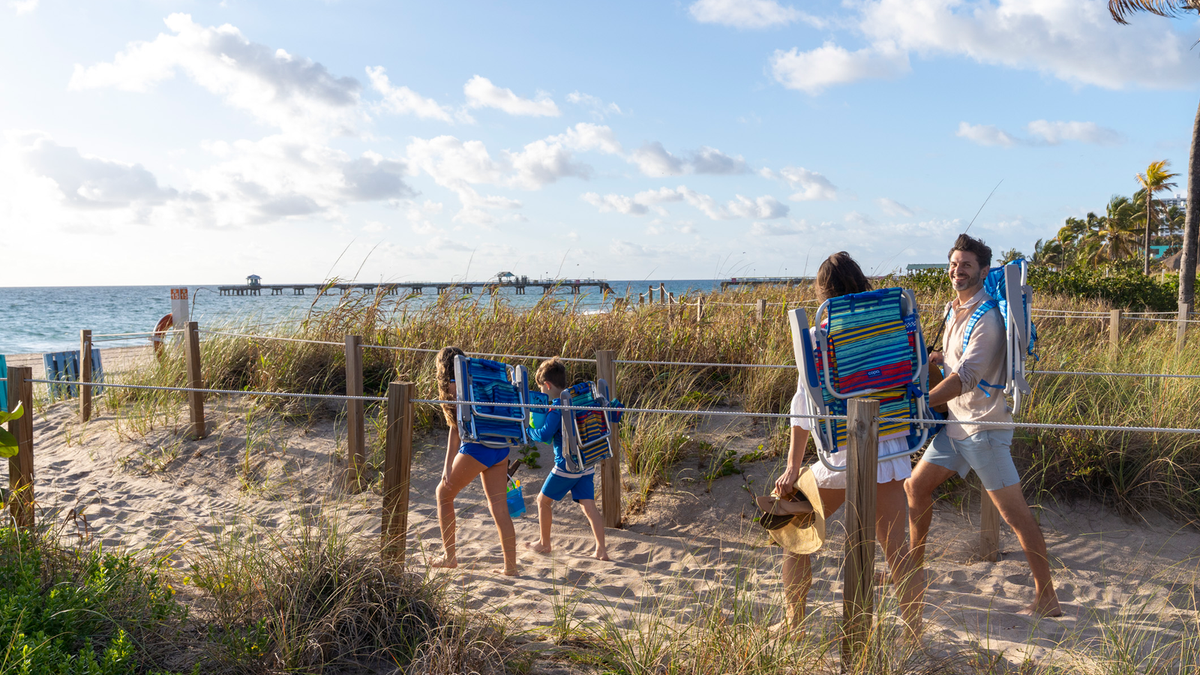
The minivan pulls into the beach parking lot at 9 AM. Grandma is already scanning for a spot close to the boardwalk ramp. Dad is mentally calculating how many trips it will take to haul everything from the trunk. The seven-year-old has her swimsuit on under her clothes. The toddler is asleep in his car seat, which means a guaranteed meltdown the moment the sun hits his face. And somewhere in the back, buried under towels and a cooler, is the umbrella that nobody tested since last summer.
Multigenerational beach trips are one of the most rewarding family experiences possible, and one of the most logistically demanding. When you are coordinating the needs of grandparents who may have mobility challenges, parents juggling infants and toddlers, and older kids who want to bodysurf from sunup to sundown, the destination itself does an enormous amount of the heavy lifting. The wrong beach turns a beautiful idea into an exhausting ordeal. The right one makes everyone feel like the trip was designed specifically for them.
This guide ranks the ten best US beach destinations for multigenerational family groups, evaluated across four criteria: physical accessibility for older adults, toddler and young child safety, amenity depth (restrooms, parking, food, rentals), and overall family-friendliness as a full-day or multi-day experience. The destinations are ordered from strong performers to the single best all-around choice for a multigenerational group. Every entry includes practical setup advice so your crew can hit the sand running.
How We Ranked These Beaches: The Multigenerational Scorecard
Most "best beach" lists are ranked by scenery or water quality. For a group spanning three generations, those factors matter less than you might expect. A spectacular beach with no boardwalk, no shade, a steep entry slope, and a parking lot a quarter-mile away is a logistical nightmare for a group that includes an 80-year-old and a two-year-old. This ranking uses a four-category scoring model built around the realities of multigenerational travel.
The Four-Category Scoring Model
| Category | Weight | What We Evaluated |
|---|---|---|
| Accessibility | 30% | Boardwalks, beach wheelchairs, parking proximity, ramp availability, terrain firmness |
| Child Safety | 25% | Wave intensity, drop-off depth, lifeguard presence, water clarity, rip current risk |
| Amenity Depth | 25% | Restrooms, showers, food access, gear rentals, shade structures, nearby lodging |
| Full-Day Livability | 20% | Crowd management, off-beach activities, afternoon shade availability, return-visit value |
Beaches are ranked #10 through #1, with #1 representing the destination that scores highest across all four categories for a group that genuinely spans from grandparents to toddlers. Scenic beauty is noted where relevant but does not drive the ranking.
#10: Coronado Beach, San Diego, California
Coronado Beach earns its spot for the sheer width of its shoreline and the firmness of its sand, both of which matter enormously for grandparents navigating beach terrain. The beach sits adjacent to the historic Hotel del Coronado, which provides an unusual density of nearby amenities for a public beach. Restrooms are well-maintained, parking is available via the Coronado Ferry Landing and at metered spots along Ocean Boulevard, and the overall vibe is calm enough that you are not fighting the crowd intensity of a major urban beach.
The water here can be cold by East Coast standards, which actually works in favor of multigenerational groups: the colder Pacific temperatures tend to moderate wave size, and the beach's natural shape creates gentle, manageable surf for children. Lifeguard coverage is consistent through the peak summer months. The wide flat stretch of sand makes it far easier to push a stroller or assist an older family member than at most California beaches where the sand is soft and steeply sloped toward the water.
Where it falls short: Coronado is not the most accessible beach in the country for wheelchair users. The crossing via the Coronado Bridge or the ferry adds a logistical layer for large groups, and parking can fill quickly on summer weekends. The Pacific water temperature will deter some older swimmers and very young children from spending extended time in the water.
Setup tip: Arrive before 9 AM to claim a spot on the flat hard-packed sand near the water's edge, which is significantly easier to navigate than the soft upper beach. Bring your own shade, because natural shade is nonexistent here. A well-anchored beach umbrella or a compact canopy is non-negotiable given the exposure.
#9: Siesta Key Beach, Sarasota, Florida
Siesta Key's quartz sand is genuinely exceptional for multigenerational groups, and not just because it photographs beautifully. The fine white quartz grain stays cooler underfoot than typical beach sand, which makes a meaningful difference for toddlers walking barefoot and older adults with circulation sensitivities. The National Park Service notes that quartz sand reflects rather than absorbs heat, which is a practical advantage on a full beach day in Florida's summer sun.
The Gulf of Mexico water at Siesta Key is warm, shallow for a long distance from shore, and calm by default. There are no significant rip current threats under normal conditions, and the gentle slope of the seafloor means toddlers can splash at the edge while older kids wade out further without hitting dangerous depth quickly. Lifeguards are stationed during peak season. The beach park itself includes pavilions, picnic tables, restrooms, outdoor showers, and a volleyball area, making it one of the most fully equipped public beach parks on the Gulf Coast.
Where it falls short: Parking is notoriously competitive at Siesta Key, and the lots fill completely by mid-morning on any summer weekend. Shuttle services operate from remote parking areas, but that adds complexity for groups traveling with a lot of gear. The beach is also extremely popular, which means crowd density can undermine the otherwise excellent environment.
Setup tip: Secure the pavilion area for your base camp if the group includes older adults who need consistent shade and a table surface. Arrive at opening time (typically 8 AM) to maximize parking options. The calm water and soft sand make this an ideal location for setting up multigenerational beach chairs in a semicircle facing the water, with a shade structure at the center.
#8: Cape Hatteras National Seashore, North Carolina
Cape Hatteras offers something most beach destinations cannot: space. The National Seashore stretches roughly 70 miles along the Outer Banks, meaning that even on a busy summer weekend, the beaches never approach the density of a resort town. For multigenerational groups who value the ability to spread out, set up a proper base camp, and not feel sandwiched between strangers, this openness is a significant advantage. The National Park Service maintains the beaches, which means facilities are reliable and the environment is protected.
The Atlantic-facing beaches here produce more active surf than Gulf Coast alternatives, which works well for older children and teenagers who want genuine wave action. The same surf demands more attention for young children and requires a thoughtful setup location. The NPS Cape Hatteras beach guide provides current conditions and lifeguard coverage schedules, which should be consulted before any trip with young swimmers.
Accessibility at Cape Hatteras has improved substantially. Several access points now feature beach wheelchairs available for free loan, and beach mats have been installed at primary access points to create firmer surfaces from the parking area to the water. The villages along the Outer Banks, particularly Avon and Frisco, provide grocery options and local restaurants within a short drive of most beach access points.
Where it falls short: The drive to reach the Outer Banks is long from most major cities, and the single road access via NC-12 means that storm or accident closures strand everyone. Lodging options range widely in quality, and the most accessible beach houses book out a year in advance for peak summer weeks.
#7: Clearwater Beach, Florida
Clearwater Beach functions like a beach destination with resort infrastructure already built in, which makes it one of the most turnkey options for a multigenerational group that does not want to solve logistics from scratch. The main beach area along Pier 60 features a consistent strip of soft white sand, calm Gulf water, lifeguard coverage, public restrooms, outdoor showers, and a pier with evening entertainment. Everything a large family group needs is within a short walk of the primary beach access points.
The pier itself is worth noting for accessibility: it extends over the water and gives older family members who do not want to navigate the sand a structured, paved vantage point to watch the water and the activity below. The Clearwater Beach Rec Complex offers beach wheelchair rentals, and the main beach access ramp is wide enough to accommodate strollers and mobility aids side by side. Parking is available in the city garage adjacent to the beach, though rates are significant during peak periods.
The Gulf water at Clearwater is warm, clear, and shallow for a generous distance from shore. The wave action is minimal under typical conditions, making it genuinely safe for toddlers and non-swimmers. For older adults who want to actually get in the water rather than observe from the shore, this low-barrier entry is a meaningful quality-of-life factor.
Where it falls short: Clearwater Beach is a popular tourist destination, and the crowd density in summer reflects that. The commercialization of the surrounding area, while convenient, creates a resort-town feel that some families find less appealing than a more natural beach environment. Accommodations directly on or near the beach carry premium pricing.
#6: Virginia Beach, Virginia
Virginia Beach is one of the few US beach destinations with a genuine urban boardwalk that is fully ADA-compliant, which changes the calculus entirely for multigenerational groups. The 3-mile boardwalk runs parallel to the beach and is wide, paved, and accessible for wheelchairs, scooters, and strollers. Grandparents who cannot easily navigate soft sand can walk or roll the entire length of the boardwalk and still have a full beach experience, including ocean views, food vendors, and seating areas. This is not a minor amenity; it is a structural advantage that most beach destinations simply do not offer.
The Atlantic water at Virginia Beach has more wave action than Gulf destinations, but the beach is wide and the wave intensity is generally manageable for older children with adult supervision. Lifeguard coverage is extensive and well-organized during peak season. The beach itself is broad and flat, with compact sand near the water's edge that is much easier to navigate on foot than the loose upper beach.
Virginia Beach's amenity depth is exceptional: hotels, restaurants, and shops line the boardwalk, meaning the group does not need to pre-pack every supply or food item. A grandparent who wants an air-conditioned break can step off the beach and into a restaurant without the family needing to pack up entirely. This flexibility is enormously valuable on a long beach day with mixed energy levels across generations.
Setup tip: For the best of both worlds, set up your beach base near a boardwalk access point so older family members can transition between sand and boardwalk easily. Keep your gear compact and portable so the group can shift positions as the afternoon sun moves. Detailed packing advice for exactly this kind of trip is covered in our guide to what to pack for a beach day.
#5: Gulf Shores, Alabama
Gulf Shores punches well above its name recognition for multigenerational beach travel. The beaches here offer the same white sand and turquoise Gulf water as their more famous Florida neighbors, but with noticeably lower crowd density, more affordable accommodations, and a beach park infrastructure that rivals anything on the Gulf Coast. Gulf State Park Beach, the anchor of the Gulf Shores beach system, features over two miles of managed beach with full restroom facilities, picnic pavilions, a fishing pier, and a nature center that provides off-beach programming for kids and grandparents who want a break from the sun.
The Gulf water at Gulf Shores is shallow and warm, and the wave activity is minimal. The beach is wide and flat, making navigation easy for the full age range of a multigenerational group. Gulf State Park also operates an accessible beach mat system at its main access point, creating a firmer walking surface from the parking lot to the water's edge.
The pricing environment at Gulf Shores is materially more accessible than Destin or Panama City Beach for comparable beachfront accommodations. For a multigenerational group renting a large beach house to sleep everyone under one roof (the single most effective logistical choice for these trips), Gulf Shores offers options at price points that make multi-generational trips financially viable for more families.
Where it falls short: Gulf Shores requires driving, and the nearest major airports are Mobile (about an hour away) and Pensacola (also roughly an hour). Families flying in will need to rent a vehicle large enough for the whole group, adding to trip planning complexity. The area also sees significant spring break and summer peak crowds that affect both beach density and accommodation pricing.
#4: Cannon Beach, Oregon
Cannon Beach earns its place in the top five for a specific type of multigenerational family: the group where older kids and teenagers are part of the equation, where the grandparents are active and curious rather than seeking warm-water wading, and where the family values natural drama over resort convenience. The iconic Haystack Rock is one of the most photographed beach landmarks in the country, and the tidepools at its base are a genuine educational experience for children of any age. The Ecola State Park immediately north of Cannon Beach offers accessible overlook trails with extraordinary Pacific views that grandparents with limited mobility can navigate on paved surfaces.
The beach itself is broad and firm at low tide, making it navigable for wheelchairs and strollers when conditions are right. The town of Cannon Beach is compact, walkable, and filled with galleries, coffee shops, and restaurants within easy reach of the beach access points. This town-beach integration means that a multigenerational group can split naturally: some members stay on the beach, others explore the town, and the group reconvenes for lunch without a major logistics operation.
The Oregon Coast is not a swimming beach in the traditional sense. The Pacific water is cold year-round, and significant wave action and rip current risk make unsupervised swimming dangerous. This is a beach for walking, exploring, watching, and experiencing, not for toddlers wading in gentle surf. Families with very young children who need water play should note this clearly.
Best season: Late July through September offers the most stable weather. The coast can be dramatically foggy and cool even in summer, which is part of its appeal but requires different packing than a Florida or Gulf Coast trip.
#3: Hilton Head Island, South Carolina
Hilton Head Island is engineered for exactly the kind of multigenerational experience this guide is describing, even if that was not the original intention. The island's strict architectural codes mean that development is low-density and shaded by mature trees right up to the beach access points. The beaches are wide, the Atlantic surf is moderate, and the network of paved multi-use paths that crosses the island gives mobility-limited family members the ability to travel between beach access points, restaurants, and accommodations without navigating soft sand or high-traffic roads.
The island operates a beach wheelchair loan program through the town, and most of the main beach access points have beach mats extending from the parking area to the waterline. Lifeguard coverage at the primary public beach access points is consistent during peak season. The accommodation mix on Hilton Head spans from resort hotels with all-inclusive amenities to large multi-bedroom vacation rental homes that can comfortably house a full multigenerational group.
For older children and teenagers, Hilton Head offers a range of activities beyond the beach itself: kayaking, paddleboarding, golf, dolphin watching tours, and the Pinckney Island National Wildlife Refuge. This activity breadth is a meaningful advantage when planning a multi-day trip where the whole family needs to stay engaged. Grandparents who prefer a structured activity to unstructured beach time will find options at every energy level.
Setup tip: The most accessible and least crowded public beach access on Hilton Head is generally found at Coligny Beach Park, which has the most complete amenity infrastructure including a playground, restrooms, showers, and a small retail area. The beach here is wide enough that even on a busy weekend, you can establish a proper base camp with a shade structure and multiple chairs without feeling crowded.
For families planning their first multigenerational beach trip, our comprehensive guide to a complete beach setup for families without the chaos walks through exactly how to organize your group's gear, positioning, and timing for a smooth full-day experience.
#2: Myrtle Beach, South Carolina
Myrtle Beach is the most fully realized multigenerational beach infrastructure in the Eastern United States, and it earns the #2 ranking because of the sheer density and quality of everything that surrounds the beach itself. The 60-mile Grand Strand beach corridor means that families can find a specific section of beach that matches their needs exactly: quieter residential areas to the north and south for families who want space, and the main Myrtle Beach strip for families who want proximity to every conceivable amenity.
The beach itself is wide, flat, and has gentle Atlantic surf with lifeguard coverage at designated sections throughout the season. The hard-packed sand near the water's edge is firm enough for wheelchair navigation and stroller use. Multiple beach access points along Ocean Boulevard include ramps, restrooms, and outdoor showers. The city maintains a beach wheelchair loan program through several access points, and the main beachfront area is served by a paved promenade that gives non-sand-walkers a parallel route along the water.
What sets Myrtle Beach apart from every other destination in this ranking is the activity ecosystem for the full age range. Within a short drive or walk of most beachfront accommodations, a multigenerational group can access: mini golf, Broadway at the Beach (a large entertainment complex), the SkyWheel Ferris wheel, the Ripley's Aquarium, multiple arcade and entertainment centers, and dozens of restaurant options at every price point. On a multi-day trip when weather interrupts beach time or when certain family members simply need a break from the sun, the surrounding entertainment infrastructure absorbs the group without anyone needing to plan ahead.
For grandparents specifically, the flat terrain of the boardwalk and the surrounding commercial strip is navigable even with limited mobility. The sheer number of golf cart rentals and accessible transportation options within the resort area makes it possible for older family members to move independently without relying on the rest of the group for every trip.
Where it falls short: The commercial density that makes Myrtle Beach so functional for large groups also makes it feel less like a natural beach experience. The main strip is busy, the crowds are real, and the aesthetic leans heavily toward tourism. Families who prioritize a pristine, uncrowded beach over logistical convenience should look elsewhere. Myrtle Beach is a destination that rewards practicality over idealism.
#1: Cape May, New Jersey
Cape May takes the top ranking because it is the only destination on this list that scores strongly across all four evaluation categories simultaneously, without a significant weakness in any of them. The combination of Victorian architecture, a calm protected bay option for non-swimmers and young children, a genuine historic downtown walkable from the beach, and one of the most well-maintained public beach systems on the entire East Coast creates a multigenerational experience that is genuinely irreplaceable.
The beach at Cape May is wide and flat, with Atlantic surf that is moderate and consistent with lifeguard coverage throughout the summer season. Beach tags are required for adults (a minor logistical step that actually results in better-managed, less overcrowded beaches compared to free-access beaches of similar popularity). The boardwalk area near the Washington Street Mall provides a paved, shaded, fully accessible loop that grandparents with mobility limitations can navigate comfortably while the rest of the group is on the sand.
The historic downtown of Cape May is genuinely walkable from the beach, meaning a multigenerational group can transition from beach mode to town mode without a vehicle. Grandparents who want air conditioning and a proper lunch can walk to a Victorian-era restaurant while parents remain with children at the water. This town-beach integration at walkable scale is rare and valuable. The City of Cape May's official beach guide outlines tag requirements, access points, and facility details.
Cape May also offers the Sunset Beach option on the Delaware Bay side, where the water is dramatically calmer and the bottom is firm and shallow for an extraordinary distance from shore. For a multigenerational group where the toddlers need a zero-risk water experience, Sunset Beach functions as a complementary option to the Atlantic-facing main beach, giving the family two completely different water environments within minutes of each other.
Accessibility infrastructure at Cape May is among the best on the East Coast. Beach wheelchairs are available through the city's beach tag office, and the main beach access points feature beach mats extending from the boardwalk to the water. The terrain from most accommodations to the beach is flat and walkable. The Victorian-era B&Bs and hotels that define Cape May's lodging scene include a growing number of accessible-room options, though large multigenerational groups should book vacation rental homes to ensure enough space for everyone.
Best season: Late June through Labor Day for full beach infrastructure and lifeguard coverage. September is genuinely excellent at Cape May: the water is still warm from summer, the crowds drop significantly, and the town's restaurants and shops remain open. For multigenerational groups flexible on dates, a September trip to Cape May may be the single best value in US beach travel.
What Every Multigenerational Beach Setup Actually Needs
The destination carries half the load. The gear carries the other half. A multigenerational beach day fails at setup more often than it fails at location choice. When your group spans grandparents to toddlers, the equipment requirements are more specific than a standard family beach day, and the consequences of under-preparing are felt by everyone.
Shade: The Non-Negotiable Foundation
Older adults and very young children share one critical vulnerability: both are at elevated risk from prolonged sun exposure, and neither can self-regulate as effectively as healthy adults in their prime. This means shade is not optional for a multigenerational group. It is the structural foundation of the entire setup.
A quality beach umbrella or canopy needs to do three things: stay anchored in wind, cover enough area for the full group, and set up without requiring significant physical effort from whoever is doing the assembly. Copa's shade solutions are built around the brand's patented Anchor Max® technology, which drives the stake deeper and more securely into sand than conventional umbrella poles. In a beach environment where an afternoon sea breeze can turn a poorly anchored umbrella into a projectile, this kind of engineered anchoring system is a genuine safety feature, not just a convenience claim. The difference between an umbrella that stays put through changing wind conditions and one that needs constant repositioning is the difference between a relaxed afternoon and an exhausting one.
For a multigenerational group, consider a two-shade setup: a larger central canopy that covers the chairs and creates a communal shaded space, plus a secondary umbrella positioned to track the afternoon sun for family members who want to stay at the water's edge. This dual-zone approach gives the group flexibility as the sun moves and as different family members rotate between active water time and resting in the shade.
Seating: Matching the Chair to the Person
One of the most common multigenerational beach setup mistakes is bringing the same low-slung beach chair for every family member. Low chairs that require significant core strength to exit are genuinely uncomfortable and potentially unsafe for older adults. Very young children in low chairs can roll sideways into the sand. The seating solution for a multigenerational group needs to address a range of physical needs.
Copa's premium beach chairs are designed with multigenerational comfort in mind: supportive back angles, durable frames that hold their position on uneven sand, and materials that stay comfortable through a long afternoon in the sun. When shopping for multigenerational beach chairs, look for models with higher seat heights, armrests that provide leverage for standing, and weight capacities that accommodate larger adults. Copa's chair lineup addresses these requirements directly, and the brand's bundle packages allow families to coordinate chairs and shade in a single purchase rather than sourcing pieces from multiple places.
A practical seating configuration for a multigenerational group: position the highest and most supportive chairs at the center rear of the shade zone for grandparents, standard beach chairs for parents in the middle zone, and a beach mat or low seat option at the front edge for kids who want to be closest to the water. This layered arrangement keeps everyone within the shade zone while accommodating different comfort preferences.
The Family Beach Vacation Packing List for Multigenerational Groups
A family beach vacation packing list for a multigenerational group is longer than for a nuclear family trip, but the additions are predictable once you think through the age-range requirements systematically.
| Category | Essential Items | For Multigenerational Groups, Add |
|---|---|---|
| Sun Protection | SPF 50+ sunscreen, lip balm, UV-protective hats | Mineral sunscreen for toddlers, UPF 50+ shirts for older adults, spare sunscreen for mid-day reapplication ✅ |
| Shade | Beach umbrella or canopy | Second umbrella or side-panel canopy extension; anchoring system rated for wind ✅ |
| Seating | Beach chairs for adults | High-back supportive chairs for older adults, beach mat or sand-level seat for young children ✅ |
| Hydration | Water bottles, sports drinks | Electrolyte packets (especially for older adults in heat), insulated cooler with easy access ✅ |
| Safety | Swim vests for young children | First aid kit with blister pads (sand friction on older skin), insect repellent for evening beaches ✅ |
| Comfort | Towels, change of clothes | Lightweight blanket or wrap for grandparents who get cold in sea breeze, sand-free towels ✅ |
| Entertainment | Sand toys, books | Bocce ball or cornhole (accessible to all ages), tide pool guide if at rocky beach ✅ |
The complete family beach packing list on the Copa blog goes deeper on each of these categories with specific product recommendations and a printable-style checklist format.
The Best Beach Setup for Families: Positioning Logic
A best beach setup for families with multiple generations is not just about what you bring. It is about where and how you place it. The optimal positioning for a multigenerational group follows a simple rule: shade at the rear, activity at the front, and a clear sightline from the shade zone to the water's edge at all times.
Set the canopy or umbrella cluster about 30 to 40 feet back from the waterline. This keeps the shade zone out of the wet sand zone during tide changes while keeping the water visible from every chair. Position the group's gear in a shallow arc rather than a straight line, so that everyone in the shade has a natural view of the water and no single chair has someone's back blocking the sightline. This matters especially for grandparents who may not be walking to the water but want to watch grandchildren playing in the surf.
Designate a single bag as the "command bag" that stays in the center of the shade zone and contains: sunscreen, snacks, phone charger, first aid kit, and the car keys. Every family member knows where it is, and nobody has to dig through five bags to find sunscreen when a toddler's shoulders start to pink up.
The Multigenerational Beach Trip Decision Tree
Not every multigenerational group has the same priorities. Use this decision framework to match your family's specific profile to the right destination from this ranking.
| Your Group's Priority | Best Match | Runner-Up |
|---|---|---|
| Grandparent with wheelchair or limited mobility | Virginia Beach (#6) | Cape May (#1) |
| Toddlers and very young children (safest water) | Siesta Key (#9) or Gulf Shores (#5) | Clearwater Beach (#7) |
| Teenagers who need activity beyond the beach | Myrtle Beach (#2) | Hilton Head (#3) |
| Nature-focused grandparents and curious kids | Cannon Beach (#4) | Cape Hatteras (#8) |
| Budget-conscious large group (affordable lodging) | Gulf Shores (#5) | Cape Hatteras (#8) |
| Best overall balance across all generations | Cape May (#1) | Hilton Head (#3) |
| West Coast family, cannot travel East | Coronado Beach (#10) | Cannon Beach (#4) |
Planning the Multigenerational Beach Vacation: Timing, Logistics, and the Gear Factor
The single most impactful decision in planning a multigenerational beach vacation is not which beach to choose. It is when to go. Peak summer weekends at any of these destinations create crowd conditions that actively undermine the accessibility and amenity advantages that make them good multigenerational choices. Parking fills before the best setup spots are claimed. Beach wheelchair supplies run out. Restrooms get overwhelmed. The recommended timing for most of these destinations is the shoulder season: late May through mid-June, or Labor Day through early October.
September is particularly underrated for multigenerational travel. Water temperatures at East Coast and Gulf Coast beaches remain warm through September as a result of summer heat accumulation in shallow coastal water. Air temperatures drop into a more comfortable range for older adults and young children. Crowds thin dramatically after Labor Day. And accommodation pricing at most of these destinations drops materially in the first week of September, sometimes by 30 to 50 percent compared to August peak rates.
For the gear side of the planning equation, multigenerational groups have an advantage that smaller family units do not: the capacity to bring more without it being burdensome. When you have six, eight, or ten adults available to carry gear from the parking lot to the beach, you can bring a properly sized canopy, multiple chairs, a full-sized cooler, and everything else the group needs for a complete day. The challenge is coordination, not carrying capacity.
Copa's bundle packages address this coordination problem directly. The Deluxe Bundle and Essentials Bundle are designed so that chairs, shade, and accessories are purchased and packaged as a system, eliminating the need to source components from multiple vendors and guess at compatibility. Free shipping on bundles removes the logistical friction of a major gear purchase, which matters especially for families making a significant investment ahead of a multigenerational trip.
For families who have not yet nailed down the Fourth of July weekend destination, our guide to the best beaches for Fourth of July weekend covers peak-holiday strategy at several of these same destinations with specific crowd and logistics advice.
Frequently Asked Questions About Multigenerational Beach Vacations
What makes a beach genuinely accessible for grandparents with limited mobility?
True beach accessibility for older adults with limited mobility requires four elements working together: firm, compact surface from the parking area to the waterline (beach mats or boardwalks), parking within 200 feet of beach access, available beach wheelchair loan programs, and restroom facilities that are ADA-compliant and close to the beach area. Virginia Beach and Cape May score highest on this combination. Simply having a beach wheelchair available does not make a beach fully accessible if the parking is a quarter-mile away or the restrooms require navigating soft sand.
Are Gulf Coast beaches safer for toddlers than Atlantic Coast beaches?
Generally, yes. Gulf of Mexico beaches, particularly those along Florida's Gulf Coast and Alabama's Gulf Shores, feature warmer water, minimal wave action under typical conditions, and very gradual bottom slopes that keep dangerous depth far from shore. Atlantic Coast beaches have more variable surf, and rip current risk is present at most Atlantic-facing beaches during certain wind and swell conditions. Toddlers and non-swimmers are materially safer in Gulf water under normal weather conditions. Always check current lifeguard coverage and water condition reports regardless of destination.
How do we manage sun protection for a multigenerational group all day?
The most effective strategy is a scheduled reapplication system rather than waiting for someone to ask. Set a phone alarm for every 90 minutes. Designate one adult to run the reapplication round, starting with toddlers and oldest adults first. Keep the sunscreen in the "command bag" at the center of your shade setup so it is never buried or forgotten. For older adults and very young children, a UPF 50+ shirt or rash guard during peak sun hours (10 AM to 2 PM) significantly reduces sunscreen reliance and protects skin that is often missed in sunscreen application.
What type of beach chair works best for grandparents?
The primary requirements for a beach chair suited to older adults are: a seat height that allows the person to stand without needing to be pulled up, armrests that provide leverage for rising, a back angle that supports the lumbar region without creating neck strain, and a stable frame that does not sink or tilt on soft sand. Low-slung "zero gravity" style chairs that put the occupant nearly at ground level are generally unsuitable for older adults regardless of their comfort rating, because the exit motion requires significant core and leg strength. Copa's premium beach chairs are built for the kind of all-day use that multigenerational groups require, with frame stability and comfort features that hold up through a full beach day.
When is the best time of year for a multigenerational beach vacation?
Late May through mid-June and the first three weeks of September are the optimal windows for most East Coast and Gulf Coast destinations. Water is warm, crowds are lower than peak summer, and accommodation rates are more manageable. For Gulf Coast destinations, this timing also reduces heat intensity, which matters for older adults who may be heat-sensitive. West Coast destinations like Cannon Beach are best from late July through early September when fog is least persistent.
How far in advance should we book accommodations for a large multigenerational group?
For peak summer weeks (late June through August) at popular destinations, book large vacation rental homes six to twelve months in advance. Properties with enough bedrooms to sleep eight or more people and accessible features (ground-floor bedrooms, no-step entry, wide doorways) are the most limited inventory at any destination and the first to sell out. For shoulder season travel, three to six months of advance booking is generally sufficient for most destinations, with the exception of Cape May, which books out quickly at any time of year due to limited large-property inventory.
Is it worth bringing our own beach gear or renting on-site?
For a single-day beach trip, rental gear is a reasonable option. For a multi-day or week-long multigenerational vacation, bringing your own gear is almost always the better choice on three dimensions: quality (rental gear is typically low-end and high-mileage), reliability (rental vendors run out of inventory on busy days), and economics (a single day's rental cost for a family-sized shade setup and multiple chairs often exceeds the cost of owning equivalent gear amortized over several trips). For a multigenerational group making beach trips a regular tradition, investing in quality gear that fits the full group's needs is a one-time decision that pays off across years of use.
What is the most common mistake multigenerational beach groups make?
Underestimating setup complexity. A multigenerational group that arrives at the beach without an agreed-upon setup plan, adequate shade for everyone, and seating suited to different physical needs will spend the first hour of the beach day solving logistics instead of enjoying it. The fix is straightforward: assign roles before you leave (who carries what, who sets up shade, who handles the young children during setup), pack a checklist-based bag system, and invest in gear that sets up quickly without requiring significant physical strength. A two-minute parking-lot briefing before the group walks to the beach eliminates most of the friction.
Do we need beach tags at all of these destinations?
Beach tag requirements vary by destination. New Jersey beaches, including Cape May, require paid beach tags for adults during the summer season. South Carolina, Virginia, Florida, and most other coastal states do not charge beach access fees at public beaches, though some municipal beach parks charge parking fees. Beach tag systems, where they exist, generally result in better-managed beach environments with higher quality maintenance, cleaner restrooms, and more consistent lifeguard staffing. The cost is typically modest per person per day.
How do we handle the logistics of getting everyone and everything from the parking lot to the beach?
The most effective solution for large groups is a beach cart or wagon rated for beach terrain (large pneumatic tires that roll over soft sand), combined with a one-trip packing discipline where everything loads into the cart in a single pass from the vehicle. Assign the cart to the strongest adult and designate a second adult to guide the oldest family member and manage young children during the walk. The group moves at the pace of the slowest member. Choosing a destination with parking close to beach access, like Cape May or Clearwater Beach, reduces the distance and therefore the difficulty of this transfer significantly.
What should we look for in a beach umbrella for a multigenerational group?
The critical features in order of importance: anchoring security in wind, coverage diameter large enough for multiple chairs, UV protection rating (UPF 50+ minimum), and ease of setup without requiring significant strength. An umbrella that is rated for large coverage but cannot stay anchored in afternoon sea breezes is a hazard rather than a benefit. Copa's shade products are built around the Anchor Max® system, which provides the anchoring security that conventional twist-in umbrella stakes cannot reliably deliver in soft sand conditions. For a multigenerational group where an umbrella becoming a windborne projectile is a genuine risk to older adults and small children nearby, the anchoring system is the most important specification to evaluate.
Are there beaches in the US with dedicated multigenerational amenities?
No US beach officially markets itself as "multigenerational only," but several destinations have developed amenity combinations that serve the full age range exceptionally well. Cape May, Hilton Head, and Virginia Beach are the strongest examples: each combines accessible beach infrastructure, calm or manageable water conditions, walkable town environments, and accommodation types suited to large groups. The differentiator is not a single dedicated amenity but the combination of accessibility infrastructure, water safety, nearby services, and activity options that collectively work for grandparents, parents, and children simultaneously.
Key Takeaways for Planning the Best Multigenerational Beach Vacation
- Cape May, NJ earns the top ranking because it scores strongly across all four evaluation criteria: accessibility, child water safety, amenity depth, and full-day livability. It is the only destination on this list without a significant weakness for any family member age group.
- Gulf Coast beaches (Siesta Key, Gulf Shores, Clearwater) are the safest water environments for toddlers and non-swimmers, with warm, calm, shallow water that is materially safer than Atlantic surf under typical conditions.
- Virginia Beach's ADA-compliant boardwalk is a structural advantage that no other East Coast beach destination matches at the same scale. For a group with a grandparent who uses a wheelchair or cannot navigate soft sand, Virginia Beach may be the most important destination on this list.
- Shoulder season travel (late May–June and September) dramatically improves the multigenerational beach experience at every destination: lower crowds, better parking, available accessibility equipment, and comparable water temperatures at a fraction of the peak-season cost.
- The gear setup matters as much as the destination. Investing in quality shade with reliable anchoring (like Copa's Anchor Max® system), appropriate seating for different ages, and a systematic packing approach eliminates the most common multigenerational beach day failures before they happen.
- Use the decision tree table in this article to match your group's specific priority (mobility, water safety, teen activities, budget) to the right destination rather than defaulting to the overall top-ranked option.
- Book large vacation rental homes six to twelve months in advance for peak summer weeks. Ground-floor, accessible properties are the first to sell out at every destination on this list.
- A pre-beach logistics briefing, designated roles for setup, and a central "command bag" with shared essentials eliminate the most common source of multigenerational beach day friction: the chaotic first hour of arrival.
Shop Now
Learn more →
Share:
Portable vs. Heavy-Duty Beach Chairs: An Honest Comparison for Families Who Beach Often
How Brazilian Beach Culture Shapes the Way Families Think About Comfort and Community Outdoors