

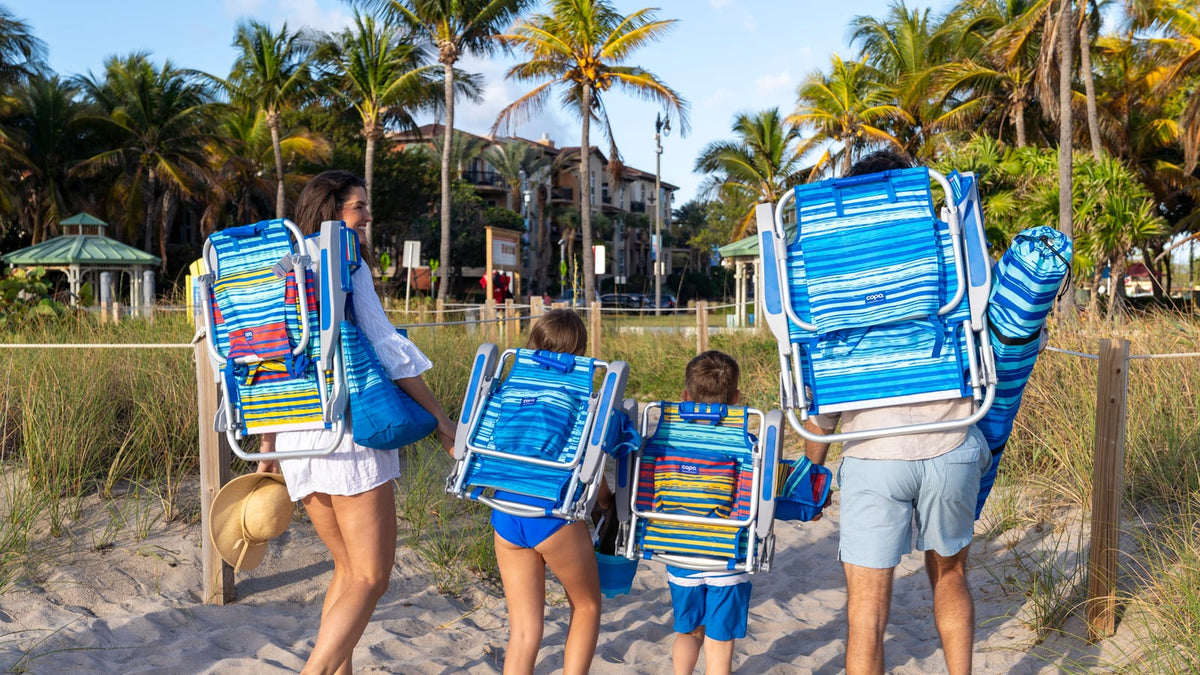
Picture this: it's 9 a.m. on a Saturday, the car is packed, the kids are buzzing with energy, and your family is finally headed to the beach. By 10:30, you've staked your spot on the sand. But by noon, someone's back is already aching from that bargain-bin folding chair, the toddler keeps sinking into the seat of the "kids' chair" you grabbed at a big-box store, and the beach bag is a tangle of broken plastic clips and frayed straps. The beach day you planned for weeks is turning into a study in discomfort.
This scenario plays out on beaches across the country every summer, and almost all of it is preventable. The difference between a miserable hour in a cheap chair and a genuinely relaxing afternoon comes down to knowing what to look for before you buy. Back support, frame weight, fabric durability, portability, and how the chair actually packs up and travels: these are the variables that separate a forgettable purchase from a chair your family reaches for season after season.
This guide cuts through the noise. It covers exactly what features matter for families, what trade-offs you'll inevitably face, and how to match the right chair to the right person and situation. Whether you're shopping for a single premium lounger or outfitting an entire crew, the framework here will help you make a decision you won't regret by the second weekend of the season.
Why Most Beach Chairs Fail Families (and What to Look for Instead)
Most beach chairs on the market are designed around a single priority: low retail price. Everything else, including comfort, durability, back support, and portability, is compromised to hit a price point. For a solo traveler heading to the beach twice a year, that trade-off might be acceptable. For a family using chairs multiple times a month, sometimes with kids, sometimes with grandparents, those compromises compound quickly.
The core problem with budget beach chairs is structural. They typically use thin aluminum tubing that bends under repeated use, nylon webbing that loses tension after a season, and plastic hardware that cracks in UV exposure. The result is a chair that feels adequate in the store parking lot and genuinely uncomfortable by the third beach trip. Armrests that flex, seat backs that sag, and legs that sink unevenly into sand are not minor inconveniences: they're the kind of cumulative discomfort that turns a family beach day into a chore.
For families specifically, the chair requirements are more demanding than for solo users. You need chairs that:
- Support a range of body types and sizes, from grandparents to teenagers to parents carrying toddlers on their laps
- Hold up to the rough-and-tumble reality of kids climbing in and out repeatedly
- Pack and carry easily without adding significant weight to an already loaded family haul
- Resist the corrosive combination of saltwater, sand, and UV rays over multiple seasons
- Offer genuine back support for adults who may spend three to five hours seated
None of these requirements are unreasonable, but they do rule out most of what fills the lower price tiers of beach chair retail. The good news is that knowing exactly what to look for makes the upgrade obvious, and the long-term value of a genuinely well-made chair far outpaces the savings from buying cheap and replacing annually.
The Four Pillars of a Family-Grade Beach Chair
Before comparing specific features, it helps to have a framework. Every beach chair purchase for a family context should be evaluated against four core pillars: support, portability, durability, and adaptability. A chair that scores well on all four is worth paying for. A chair that excels in one but fails in another is a specialized tool, not a family workhorse.
Support covers back angle, lumbar positioning, seat depth, and armrest height. Portability covers total weight, pack size, and how easy it is to carry across sand with two hands already full of other gear. Durability covers frame materials, fabric quality, hardware construction, and resistance to saltwater and UV degradation. Adaptability covers reclining positions, weight capacity, ease of adjustment, and whether the chair suits multiple family members or just one.
Use these four pillars as your filter when evaluating any chair, including the Copa options covered later in this guide.
Back Support: The Feature That Matters Most for Adults
The best beach chairs for back support are not simply chairs with a higher seat back. True lumbar support in a beach chair comes from a combination of seat angle, back angle, seat depth, and the firmness of the supporting fabric, all working together to keep the spine in a neutral position over hours of use.
Most standard beach chairs position the sitter in a bucket configuration: hips lower than knees, back reclined at roughly 100 to 110 degrees, with no lateral support for the lumbar spine. This feels comfortable for about 20 minutes. After that, the hip flexors tighten, the lower back rounds, and the discomfort that starts as mild tension becomes a full-blown ache by early afternoon.
A chair engineered for back support addresses this through several design choices:
- Adjustable reclining positions: The ability to shift between upright (for reading or eating), moderate recline (for conversation), and deep recline (for napping) distributes pressure across different muscle groups and prevents the fatigue that comes from holding one position for hours.
- Seat height relative to the ground: Low-slung chairs look relaxed but force the hips into deep flexion, which loads the lower back. A moderate seat height keeps the hips at a more neutral angle.
- Fabric tension: A seat that sags creates a hammock effect, which rounds the lower back. Taut, well-tensioned fabric maintains a more supportive seating surface.
- Padded or contoured back panels: Thin nylon webbing offers no contouring. A padded back or one with structured channeling provides meaningful lumbar contact.
For families, back support matters most for the adults in the group, particularly parents who are seated for long stretches while managing kids, and older family members who may have existing lower back concerns. Investing in genuinely supportive chairs for the adults in your group pays dividends in how everyone feels at the end of the day, and in whether the family actually wants to come back next weekend.
What to Look for in Chair Specifications
When comparing chairs, the specifications that most reliably indicate back support quality are: seat back height (taller is generally better for adults), the number of recline positions, and whether the product description specifically mentions lumbar or back support features. Weight capacity is also a proxy for structural quality: a chair rated for 250 lbs is built to different tolerances than one rated for 300 lbs, and the higher-rated chair will generally maintain its structural integrity (and therefore its support geometry) longer under regular use.
Lightweight vs. Sturdy: How to Avoid a False Choice
Lightweight beach chairs and sturdy beach chairs are often presented as opposites, as if buying light means buying fragile and buying sturdy means buying heavy. This is a false choice that better materials have largely eliminated, but it persists because it's still true at the low end of the market.
The real variable is material quality, not a fundamental engineering trade-off. Here's how the common frame materials stack up:
| Frame Material | Typical Weight | Corrosion Resistance | Durability Under Load | Best For |
|---|---|---|---|---|
| Thin-wall aluminum (budget) | 3–4 lbs | ⚠️ Moderate | ❌ Bends with heavy use | Occasional solo use |
| Heavy-gauge steel | 7–10 lbs | ❌ Rusts in saltwater | ✅ Very strong | Backyard, not beach |
| Aircraft-grade / thick-wall aluminum | 4.5–6 lbs | ✅ Excellent | ✅ Holds shape under load | Regular family beach use |
| Powder-coated steel | 8–12 lbs | ⚠️ Depends on coating quality | ✅ Very strong | Stationary setups |
| Fiberglass composite | 3–5 lbs | ✅ Excellent | ⚠️ Can crack under impact | Ultralight specialist use |
For families heading to the beach regularly, thick-wall aluminum is the material that best resolves the lightweight-versus-sturdy tension. It resists the saltwater corrosion that kills steel frames, stays light enough to carry across a long beach without exhaustion, and holds its structural geometry under the kind of repeated loading that comes with kids climbing in and out of chairs all day.
The fabric matters just as much as the frame. Polyester with UV inhibitors holds color and tension longer than untreated nylon, which fades and stretches quickly under direct sun. High-denier polyester (typically 600D or higher) resists tearing and abrasion, which matters when chairs are repeatedly dragged across sand and packed into car trunks. Breathable mesh panels in the seat and back help with heat management, which is a real comfort consideration when temperatures climb.
What "Lightweight" Actually Means in Practice
A chair marketed as "lightweight" can mean anything from 3 lbs to 7 lbs depending on the brand. For context: carrying a 6 lb chair across 400 meters of soft sand with a beach bag on one shoulder and a toddler on the other hip is a genuinely different experience from carrying a 4 lb chair. When you multiply that weight across four chairs for a family of four, the total load carried from the parking lot to the waterline becomes significant.
The most useful lightweight benchmark for families: look for chairs that pack under 6 lbs individually and fold to a size that multiple chairs can be carried together or stacked on a beach cart. A chair that folds into a shoulder strap carry bag compounds the portability benefit by freeing up a hand for other gear.
Portability and Pack Design: The Details That Actually Matter at the Beach
Portable beach chairs are defined less by their folded weight and more by how thoughtfully they're designed to be carried. A chair that folds small but has no carrying solution, or that only works with a carry strap that digs into your shoulder, is portable on paper and frustrating in practice.
The carrying system is where a lot of otherwise well-made chairs reveal their design priorities. Here's what separates genuinely portable beach chairs from chairs that merely fold:
- Integrated carry bag vs. carry strap: A carry strap keeps the chair exposed to sand, sun, and abrasion during transport. An integrated bag, or a bag that stores within the chair's own structure, protects the fabric and hardware during transit and keeps sand contained.
- Shoulder carry vs. hand carry: Shoulder-carry designs free up hands for other gear. Hand-carry loops are fine for short distances but become tiring quickly on longer walks across sand.
- Folded dimensions: A chair that folds to a compact cylinder stores more easily in a car trunk and can be carried alongside other items without awkward bulk.
- Pack time: Some chairs fold in under 10 seconds with a single motion. Others require a multi-step process that becomes irritating when you're packing up a tired family at the end of the day.
For families bringing multiple chairs, a chair with an integrated carry bag or a design that allows two chairs to be carried together on a single shoulder is significantly more practical than individual carry solutions. This is one area where the design philosophy of the brand matters: a company that genuinely thinks through the family beach experience will engineer the carry system as carefully as the seating system.
Beach Chairs with Carrying Bag: Why It's a Non-Negotiable Feature
Beach chairs with a carrying bag are not just a convenience feature; they're a durability feature. Sand is one of the most abrasive substances a chair will encounter, and a chair that travels without protection accumulates sand in every hinge, joint, and fabric fold. Over time, that sand works like sandpaper on the moving parts of the chair, accelerating wear on both the frame and the fabric.
A quality carry bag also protects the chair fabric from UV degradation during transport in the back of a car or truck, where heat and light exposure can be significant. Families who store their beach chairs in a garage or shed between trips will find that a bag keeps the chair cleaner and in better condition between uses.
When evaluating bags, look for: reinforced stitching at stress points, a zipper or closure that resists sand infiltration, and enough room to pack the chair without forcing it in at awkward angles that stress the frame or fabric.
Copa Beach Chairs: What Sets Them Apart for Families
Copa has built its chair lineup around the specific demands of the family beach experience, and the differences are visible in both the design choices and the product specifications. The brand's approach prioritizes multigenerational comfort, meaning the chairs are engineered to work well for adults of different sizes and needs, not just a single idealized user.
Copa's beach chairs are built on a foundation of high quality beach chairs design principles: durable, rust-resistant aluminum frames, high-denier polyester fabrics with UV protection, and thoughtful ergonomic features including padded armrests and adjustable reclining positions. The result is a chair that feels substantively different from budget alternatives the moment you sit in it, and that maintains that quality across a full season of regular use.
For families who want to understand the full Copa product ecosystem, including the shade and bundle options that pair with the chairs, the complete beach setup guide for families walks through how the different components work together as a coordinated system.
The Copa Beach Chair Feature Set
What distinguishes Copa chairs from the field isn't any single feature but the combination of features that matter specifically in a family context:
- Rust-resistant aluminum frames that hold up to repeated saltwater exposure without the corrosion that compromises budget chairs after a single season
- Adjustable reclining positions that allow the chair to shift from upright for reading or eating to a relaxed recline for lounging, serving different family members and different moments in the same beach day
- Padded armrests that provide genuine comfort rather than bare aluminum tubes, which become painfully hot in direct sun
- High-denier polyester fabrics that resist fading and stretching, maintaining their support geometry across seasons rather than sagging progressively
- Carry bag design that protects the chair during transport and storage, contributing to long-term durability
The chairs are also designed to complement Copa's shade solutions, including the umbrellas and cabanas that use the brand's patented Anchor Max® system. For families setting up a full beach camp, having chairs and shade designed to work together as a system simplifies the setup process significantly.
Understanding Copa's Anchor Max® Technology (and Why It Matters for Families)
While the Anchor Max® system is primarily associated with Copa's shade products rather than the chairs themselves, it's worth understanding in the context of a complete family beach setup. The Anchor Max® is Copa's patented anchoring system for beach umbrellas and shade structures, designed to keep shade securely positioned in sand even under wind conditions that would topple a standard spike-driven umbrella.
For families, this matters because shade and seating are inseparable components of a functional beach setup. A chair positioned perfectly for comfort and back support becomes far less useful if the umbrella shading it tips over every time the wind picks up. The Anchor Max® system addresses this by using a corkscrew mechanism that drives deep into the sand and locks the umbrella pole at a secure angle, providing a stable foundation that holds across a full day of changing wind conditions.
The practical implication for a family shopping for beach gear: buying Copa chairs alongside Copa shade solutions means the entire setup is designed to function as a coherent system. The chairs are sized and positioned to work within the shade footprint of Copa's umbrellas and cabanas, and the overall aesthetic is coordinated so the setup looks intentional rather than assembled from mismatched parts.
For families planning major beach outings, Copa's bundle packages pair chairs with shade solutions into a single coordinated purchase. This removes the guesswork of mixing and matching from different brands and ensures that everything works together from day one.
Feature-by-Feature Comparison: What to Prioritize at Each Budget Level
Not every family has the same budget, and not every beach trip has the same demands. The following comparison matrix maps feature priorities across three purchasing scenarios: the value-conscious family buying their first set of chairs, the regular beach family upgrading from budget gear, and the frequent-use family investing in a long-term solution.
| Feature | Entry Level ($20–$50) | Mid-Range ($50–$100) | Premium ($100–$200+) |
|---|---|---|---|
| Frame Material | Thin aluminum or steel | Aluminum alloy | Thick-wall aluminum alloy |
| Back Support | ❌ Minimal, fixed angle | ⚠️ Some recline positions | ✅ Multi-position, padded |
| Fabric Quality | Nylon webbing, fades fast | Polyester, some UV resist | High-denier polyester, UV treated |
| Weight | 3–5 lbs (fragile) | 4–6 lbs | 4.5–7 lbs (durable) |
| Carry System | ❌ Carry strap only | ⚠️ Basic bag or strap | ✅ Integrated carry bag |
| Armrests | ❌ None or bare aluminum | ⚠️ Basic plastic | ✅ Padded, wide |
| Saltwater Resistance | ❌ Rusts or corrodes | ⚠️ Partial resistance | ✅ Full corrosion resistance |
| Weight Capacity | 225–250 lbs | 250–275 lbs | 275–300+ lbs |
| Expected Lifespan | 1–2 seasons | 2–3 seasons | 4–6+ seasons |
The expected lifespan row tells the real story of total cost of ownership. A family that buys four entry-level chairs at $30 each ($120 total) and replaces them every two seasons spends $60 per season on chairs. A family that invests in four premium chairs at $120 each ($480 total) and uses them for six seasons spends $80 per season, and gets dramatically better comfort and functionality for that marginal difference. When you factor in the miserable afternoons spent in chairs that stopped being comfortable by noon, the premium option becomes an obvious value.
The Portability Decision Tree: Choosing the Right Chair for Your Situation
Not all beach trips are created equal, and the right chair for a day at a local beach with close parking is not necessarily the right chair for a half-mile hike across soft sand to a remote stretch of coastline. Use this decision framework to match chair type to situation:
Scenario 1: Short Carry, Regular Family Beach Day
Parking lot is close, you have a beach cart or wagon, kids are in tow. In this scenario, weight is less critical than comfort and features. A chair in the 5–7 lb range with padded armrests, multiple recline positions, and a carry bag is the ideal choice. Don't compromise on comfort features to save a pound you won't notice when the cart is doing the heavy lifting.
Scenario 2: Long Carry, Remote Beach Access
No cart, quarter-mile or more across sand, hands already full with a cooler and a toddler. Here, weight is the dominant variable. A genuinely lightweight beach chair (under 5 lbs) with a shoulder-carry bag that leaves hands free is essential. Look for a design that two chairs can be carried on one shoulder so you can manage the rest of the load with the other hand.
Scenario 3: Multigenerational Group, Mixed Needs
You have grandparents who need genuine back support, parents who want reclining options, and kids who need something durable. In this scenario, invest in a uniform chair that meets the highest requirements of the group: high weight capacity, strong back support, adjustable positions, and maximum durability. Everyone benefits from a better chair; nobody suffers from having more support than they strictly need.
Scenario 4: Frequent Traveler, Airline or Destination Beach
You're flying to a beach destination and want to bring your own chairs rather than rent. Pack size becomes critical. Look for chairs that fold to a compact cylinder, have a carry bag that protects them in checked luggage or overhead storage, and weigh under 5 lbs per unit. Some premium beach chairs are designed specifically with this use case in mind and pack small enough to check as luggage or fit in a large bag.
Sand and Saltwater Resistance: The Durability Factor Nobody Talks About Enough
Sand and saltwater are a uniquely destructive combination for beach gear. Sand is abrasive to every moving part of a folding chair: the hinges, the adjustment mechanisms, the fabric weave, and the joints where the frame meets the fabric. Saltwater accelerates oxidation on any metal that isn't fully corrosion-resistant, and the combination of salt, UV radiation, and heat degrades untreated fabrics at a rate that makes cheap chairs look visibly aged by mid-season.
The best high quality beach chairs address this through a combination of material choices and design details that are easy to overlook when shopping online but make a significant difference over time.
Key durability indicators to look for:
- Anodized or powder-coated aluminum frames: Anodizing creates a surface layer that is harder than the underlying aluminum and fully corrosion-resistant. This is the standard for quality beach chairs and should be non-negotiable for any chair that will see regular saltwater exposure.
- Rust-proof hardware: Every bolt, rivet, and hinge should be stainless steel or aluminum. A single steel bolt in a saltwater environment will rust, and that rust migrates to the surrounding fabric and frame over time.
- UV-stabilized fabric: UV radiation breaks down polymer chains in fabric, causing fading, brittleness, and eventual tearing. UV-stabilized or UV-resistant polyester contains additives that slow this process significantly, extending the fabric's life from one or two seasons to four or more.
- Reinforced stress points: The points where the frame attaches to the fabric are the first to fail on cheap chairs. Look for chairs with reinforced attachment points, either through extra fabric layers, metal grommets, or heavy-duty stitching.
One maintenance habit that extends the life of any beach chair dramatically: rinse it with fresh water after every beach trip. Salt residue left on the frame and fabric continues to work on the materials between uses. A 30-second rinse with a garden hose removes the salt before it can do damage, and it takes far less time than shopping for replacement chairs two years early.
How to Shop for the Full Beach Setup, Not Just the Chair
The chair is the centerpiece of a beach setup, but it doesn't function in isolation. For families, the full setup includes shade, storage, and transport logistics, and the choices in each category affect how the others work. A chair that's optimally positioned for comfort but sits outside the shade footprint of a poorly designed umbrella is a net negative for the afternoon.
Shopping for a coordinated beach system, rather than individual items from different brands, simplifies a lot of decisions. When chairs and shade are designed to work together, the positioning, aesthetic, and functional integration are already solved by the manufacturer. Copa's bundle approach addresses this directly: the Deluxe Bundle and Essentials Bundle pair chairs with shade solutions into a single purchase that's been designed as a system from the start.
For families planning a beach day that works seamlessly from setup to packdown, the ultimate family beach packing list covers everything that goes into a well-prepared beach bag, including the gear categories where quality investments pay off most.
The other coordination benefit of a system purchase: free shipping on bundles means the total cost is often more favorable than buying components individually from different sources, and the single-order logistics are simpler for families who are already managing enough complexity in planning a beach outing.
Red Flags When Buying Beach Chairs Online
Online shopping for beach chairs is convenient but creates a specific set of risks that don't exist when you can physically test a chair before buying. Here are the red flags that consistently indicate a chair will underperform in real use:
- Weight capacity under 250 lbs: A chair rated below 250 lbs is engineered to tighter tolerances and will begin showing structural fatigue faster under regular use by adults of average size.
- No mention of frame material: A product description that says only "metal frame" without specifying aluminum, aluminum alloy, or steel is hiding something. Quality chairs lead with their frame material because it's a genuine selling point.
- Carry strap only (no bag): As covered earlier, a chair without a carry bag is designed for infrequent use. A brand that doesn't include a bag isn't thinking about the long-term durability of the product.
- Vague fabric descriptions: "Durable fabric" or "breathable material" without specifying fiber type, denier rating, or UV treatment is a signal that the fabric is a low-cost commodity input. Quality brands specify polyester, denier rating, and UV resistance because these details differentiate their product.
- Only one recline position: A beach chair with no adjustment isn't engineered for extended use. Multiple recline positions are a baseline feature of any chair designed for hours of comfortable sitting.
- Photos showing loose fabric: Product photos that show a visibly saggy or loosely-tensioned seat are showing you exactly what the chair will feel like to sit in. Taut fabric in product photos indicates proper tensioning and better support geometry.
Positive signals that indicate a genuinely well-made chair include: a specified weight capacity of 300 lbs or more (indicating over-engineering and longer structural life), a named fabric with UV rating, anodized or powder-coated frame finish, a reinforced or integrated carry bag, and a warranty of two years or more.
Copa vs. Generic Beach Chairs: An Honest Comparison
To make this comparison genuinely useful, it helps to be direct about where Copa chairs stand relative to the broader market across the features that matter most for families.
| Feature | Copa Beach Chairs | Typical Big-Box Brand | Generic Online Brand |
|---|---|---|---|
| Frame Construction | ✅ Rust-resistant aluminum alloy | ⚠️ Varies by price tier | ❌ Often thin or unspecified |
| Back Support | ✅ Multi-position recline, padded | ⚠️ Limited recline options | ❌ Fixed or minimal |
| Fabric Quality | ✅ UV-treated high-denier polyester | ⚠️ UV treatment not always specified | ❌ Unspecified, often fades fast |
| Carry System | ✅ Integrated carry bag | ⚠️ Basic bag or strap | ❌ Carry strap only typically |
| Armrests | ✅ Padded, wide | ⚠️ Basic or absent at lower tiers | ❌ Often absent or bare |
| System Integration | ✅ Designed to pair with Copa shade | ❌ No coordinated system | ❌ No coordinated system |
| Brand Design Philosophy | ✅ Family beach experience focus | ⚠️ General outdoor market | ❌ Price-driven, generic |
The system integration row is worth dwelling on. Copa is not just selling chairs: it's selling a coherent beach experience designed around how families actually use beach gear. That design philosophy shows up in details like the Anchor Max® system for shade, the bundle packaging that coordinates chairs with umbrellas and cabanas, and the content resources that help families plan better beach days. Generic brands don't have this because they're not organized around a specific use case and user group.
Who Should Buy What: Scenario-Based Recommendations
Shopping guides that sit on the fence and refuse to give direct recommendations aren't actually helpful. Here are specific, scenario-based recommendations for different types of beach families:
If you're a family that beaches regularly (10+ trips per season): Invest in Copa's premium chairs without hesitation. The durability, back support, and carry system will hold up across a full season of heavy use, and the total cost per use will be substantially lower than cycling through cheaper chairs. Pair with the full Copa bundle for maximum system integration.
If you're a multigenerational group with grandparents and toddlers: Back support and weight capacity should be your non-negotiable priorities. Copa's multi-position recline and padded construction serve both the elderly and the adults managing toddlers on their laps equally well. The high weight capacity provides a structural safety margin that gives older family members confidence in the chair.
If you're a frequent traveler heading to beach destinations: Copa's lightweight construction and integrated carry bag make the chairs genuinely practical to transport. The compact folded profile and carry bag allow two chairs to be managed by a single person, which matters when navigating airports, resort lobbies, and long beach walks with luggage in hand.
If you're setting up a full family beach camp with shade: The Copa bundle system is the clearest path to a functional, coordinated setup. The Anchor Max® shade system paired with Copa chairs creates a complete beach camp that works as a unit, and the free shipping on bundles makes the total purchase straightforward.
If budget is genuinely constrained: Prioritize frame material and carry system over other features. A corrosion-resistant aluminum frame with an integrated bag will outlast a heavier or cheaper chair significantly, and those two features protect your investment more than any other single decision.
For families planning a major Fourth of July beach weekend or any high-traffic holiday beach day, having gear that can handle an extended setup without failure is especially important. The best beaches for Fourth of July weekend guide is a useful companion for planning those peak-season trips where setup reliability really matters.
Caring for Your Beach Chairs to Maximize Their Lifespan
The best high quality beach chairs on the market will underperform their potential lifespan without basic maintenance. The good news is that beach chair maintenance is genuinely simple and takes only minutes per trip.
After every beach trip:
- Rinse the entire chair with fresh water, paying attention to the joints, hinges, and any metal hardware. This removes salt residue before it can begin oxidizing the frame.
- Shake or brush out sand from the fabric folds and the carry bag. Sand left in contact with fabric acts as an abrasive during storage and transport.
- Allow the chair to dry fully before folding and storing. Folding a wet or damp chair creates conditions for mold and mildew in the fabric, and trapped moisture accelerates corrosion on any exposed metal edges.
Between seasons:
- Store chairs in a dry, protected location away from direct UV exposure. A garage or basement is ideal; a patio or shed with UV exposure degrades fabric even when the chair isn't being used.
- Inspect hinges and adjustment mechanisms for sand accumulation. A compressed air canister or a dry brush can clear sand from these areas before it causes wear on the moving parts.
- Check fabric tension. If the seat or back has stretched noticeably, some chairs allow for re-tensioning through adjustment at the frame attachment points.
These habits extend the life of any quality beach chair by years and ensure that the back support and structural integrity that made the chair worth buying remain intact across multiple seasons.
Frequently Asked Questions About Family Beach Chairs
What makes a beach chair good for back support?
The best beach chairs for back support combine multiple recline positions, a taut and well-tensioned seat fabric, and sufficient seat height to keep the hips in a neutral position. Padded back panels add comfort, but the structural geometry (seat angle, back angle, and fabric tension) does more for lumbar support than padding alone.
How heavy should a portable beach chair be?
For families carrying chairs across sand, a target weight of under 6 lbs per chair strikes the best balance between portability and durability. Ultra-lightweight chairs (under 4 lbs) are typically built to thinner tolerances that sacrifice longevity. Chairs over 7 lbs become genuinely tiring to carry in groups across soft sand, especially with children and other gear to manage.
Are beach chairs with carrying bags worth the extra cost?
Yes, for two distinct reasons. First, a carry bag protects the chair fabric and hardware from UV and abrasion damage during transport and storage, meaningfully extending the chair's lifespan. Second, a bag with a shoulder strap frees up hands that are needed for children, coolers, and other gear. The carrying bag is a durability feature as much as a convenience feature.
What weight capacity should I look for in a family beach chair?
A minimum of 275 lbs is a reasonable baseline for adult beach chairs in a family context. Chairs rated at 300 lbs or above are over-engineered relative to most users, which means they maintain their structural geometry and support longer under regular use. Higher weight capacity is a proxy for frame quality and longevity, not just a safety specification.
How do I stop my beach chair from sinking into the sand?
Wider leg tips distribute the load over a larger surface area and resist sinking more effectively than narrow points. Some premium chairs include widened foot caps or sand-specific leg tips for this reason. As a practical workaround, placing the legs on a flat surface (a small piece of board, a flat rock, or even a folded towel) under each leg prevents sinking in very soft sand conditions.
Can I use a beach chair on grass or a hard surface?
Yes. Most beach chairs are designed for sand but function perfectly on grass, concrete, or hard surfaces. The main consideration is that leg tips designed for sand (wide and rounded) may scratch hard floors. If you plan to use beach chairs regularly on patios or decks, look for models with removable or replaceable leg tips.
What's the difference between a beach chair and a camping chair?
Beach chairs are typically lower to the ground, have a wider seat for lounging, and are built from corrosion-resistant materials (aluminum rather than steel). Camping chairs tend to sit higher, fold more compactly for backpacking, and are built for dry environments where corrosion isn't a concern. A camping chair will work at the beach but will corrode faster and is less comfortable for extended lounging.
How many beach chairs does a family of four need?
At minimum, one chair per adult. Children under five or six typically share a chair with a parent or use a specialized kids' chair or beach blanket. For a family of two adults and two young children, two to four chairs depending on the children's ages is a practical range. For comfort-focused families, having four chairs means everyone always has a place to sit without rotating.
How do I clean sand out of beach chair fabric?
Shake the chair vigorously after folding to dislodge loose sand, then use a stiff brush or compressed air to clear sand from fabric folds and weave. Rinsing with fresh water removes fine sand from fabric fibers. Avoid using soap on beach chair fabric unless the manufacturer specifies it's safe, as some cleaning agents can degrade UV-protective treatments on the fabric.
What is the Anchor Max® system and does it affect the chairs?
The Anchor Max® is Copa's patented anchoring system for beach umbrellas and shade structures, designed to secure them in sand under wind conditions. It does not directly affect the chairs, but it's relevant for families buying a complete Copa beach setup because it ensures the shade structure that pairs with the chairs stays securely positioned throughout the day. A stable shade footprint makes the chairs underneath it significantly more usable in windy beach conditions.
Is it worth buying a matching set of beach chairs from the same brand?
For families, yes, for practical reasons beyond aesthetics. Matching chairs fold to the same dimensions, which simplifies stacking and storage. They share the same carry bag design, which allows efficient packing. And when they're designed as part of a system (as Copa chairs are), they're sized to work within the same shade footprint, which matters for positioning everyone under cover.
How long should a quality beach chair last?
A genuinely well-made beach chair with a corrosion-resistant aluminum frame, UV-treated fabric, and rust-proof hardware should last four to six seasons of regular family use with basic maintenance (rinsing after each trip and proper off-season storage). Budget chairs typically show structural fatigue, fabric stretch, and hardware corrosion within one to two seasons of similar use.
Key Takeaways
- Back support is the most important comfort feature for adults and comes from the combination of seat angle, back angle, fabric tension, and recline adjustability, not just seat back height.
- Lightweight and sturdy are not opposites at the quality tier: thick-wall aluminum alloy frames resolve this trade-off and are the standard material for beach chairs designed for regular family use.
- Beach chairs with a carrying bag are a durability investment, not just a convenience feature. The bag protects frame and fabric from UV and abrasion during transport and storage.
- The four pillars of a family-grade chair are support, portability, durability, and adaptability. Evaluate every option against all four, not just the feature that's most prominently marketed.
- Total cost of ownership favors quality: a premium chair that lasts six seasons is typically cheaper per use than a budget chair replaced every two seasons, with dramatically better comfort throughout.
- System integration matters: chairs designed to pair with coordinated shade solutions (like Copa's Anchor Max® umbrella system) create a beach setup that works as a unit rather than a collection of mismatched parts.
- Basic maintenance (fresh water rinse after every trip, dry storage between seasons) extends the life of any quality beach chair by years.
- Red flags to avoid when shopping online include unspecified frame materials, weight capacity under 250 lbs, carry strap only (no bag), and vague fabric descriptions without fiber type or UV treatment specification.
The beach chair decision is one that follows your family every single time you head to the shore. Getting it right means more comfortable afternoons, less gear replacement over time, and a setup that actually makes you want to spend more time at the beach. For families who take their beach days seriously, investing in chairs that were genuinely designed with that use case in mind is the clearest path to a better experience, starting with the very first trip you bring them on.
Shop Now
Learn more →
Share:
How to Anchor a Beach Umbrella in Sand So It Won't Fly Away
The Complete Family Beach Packing List: Everything You Need for a Stress-Free Day